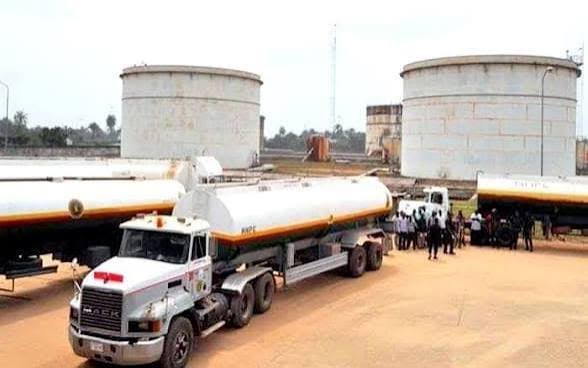
The Nigerian downstream petroleum market has recorded another round of price adjustments, with some depot operators in Calabar and Port Harcourt now selling petrol below the current ex-gantry price of the Dangote Petroleum Refinery.
The latest development is being driven largely by increased product availability and stronger competition among depot owners, giving some buyers access to petrol at rates lower than the refinery’s current benchmark.
Dangote Refinery’s ex-gantry price currently stands at N1,325 per liter, while some depots in the two southern markets have reduced their prices to as low as N1,303 per liter. That represents a difference of N22 per liter below the refinery’s rate.
Calabar Records Lowest Depot Prices
Calabar has emerged as one of the markets recording the sharpest reductions.
Data from Petroleumprice.ng showed that selected depots in the city were quoting petrol between N1,303 and N1,310 per liter on Monday, October 5.
Matrix and Soroman offered the lowest rate at N1,303 per liter, while Mainland was selling at N1,304. Northwest quoted N1,310 per liter.
The figures mean motorists and petroleum marketers sourcing products through some Calabar depots can obtain petrol below the current Dangote benchmark.
The N1,303 rate at Matrix and Soroman represents a N22 gap when compared with Dangote Refinery’s N1,325 ex-gantry price.
Port Harcourt Marketers Also Cut Prices
A similar trend has emerged in Port Harcourt, where several depot operators have reviewed their petrol prices downward.
Masters, Sigmund, TSL and Stockgap were all selling petrol at approximately N1,305 per liter after previously quoting higher prices.
The latest rate places these depots N20 below Dangote Refinery’s N1,325 ex-gantry price.
The reductions indicate that competition among suppliers is becoming an increasingly important factor in determining wholesale petrol prices in different parts of Nigeria.
Why Petrol Prices Are Falling
Industry sources have attributed the latest price cuts mainly to improved availability of petrol and competition among depot operators.
When several suppliers have substantial volumes available while demand remains relatively moderate, depot owners may be forced to reduce their selling prices to attract customers.
This appears to be what is happening along the Calabar-Port Harcourt supply corridor.
The development also highlights why petrol prices can vary considerably from one part of Nigeria to another, even when suppliers are responding to the same national market conditions.
Dangote’s Petrol Price Remains at N1,325
The Dangote refinery’s current ex-gantry price is N1,325 per liter.
The refinery had reduced its petrol price by N25 in September, moving from N1,350 to N1,325 per liter. The reduction came only nine days after the company had increased the price by N85, from N1,265 to N1,350.
The September reduction also prompted a series of adjustments at depots across Lagos, Port Harcourt, Calabar and Warri.
At the time, some coastal depots moved their prices closer to the Dangote benchmark, although individual operators continued to quote different rates depending on their supply and operating costs.
Competition Reshapes Nigeria’s Fuel Market
The latest price movement demonstrates the growing competition within Nigeria’s deregulated downstream petroleum market.
With domestic refining capacity expanding, petroleum marketers increasingly have alternatives to imported products. The Dangote refinery has become a major source of locally refined petrol, while other suppliers and depots continue to compete for market share.
In some instances, competition can push depot prices below the headline refinery price when operators are seeking to clear inventory or attract additional buyers.
For consumers, however, depot prices do not necessarily translate directly into identical pump prices because retailers still have to account for transportation, logistics, operating expenses and other distribution costs.
Pump Prices May Differ From Depot Rates
The difference between wholesale depot prices and what motorists pay at filling stations remains important.
For example, petrol stations in Lagos have recently adjusted their pump prices in response to changes in wholesale costs. Some MRS and Ardova outlets were reported to have reduced their prices to around N1,355 per liter.
This means a fall in depot prices can eventually influence retail prices, but the size and timing of the reduction will depend on the location of the filling station and the cost of transporting the product there.
Transport expenses are particularly significant for states farther away from major coastal supply centres.
What the Latest Development Means for Consumers
The emergence of petrol prices below Dangote’s ex-gantry rate could provide some relief to marketers and potentially support lower pump prices if the trend continues.
It also shows that competition is becoming more visible in the downstream sector as suppliers compete aggressively for customers.
However, the current reductions do not necessarily mean petrol prices will continue falling nationwide.
Global crude prices, refinery pricing decisions, exchange-rate movements, transportation expenses and regional supply conditions can all influence the final price of petrol.
For now, motorists in parts of Calabar and Port Harcourt are benefiting from a notable price gap, with some depots selling petrol more cheaply than Dangote Refinery’s current benchmark.
If increased supply and strong competition persist, more markets could see similar adjustments in the days ahead.