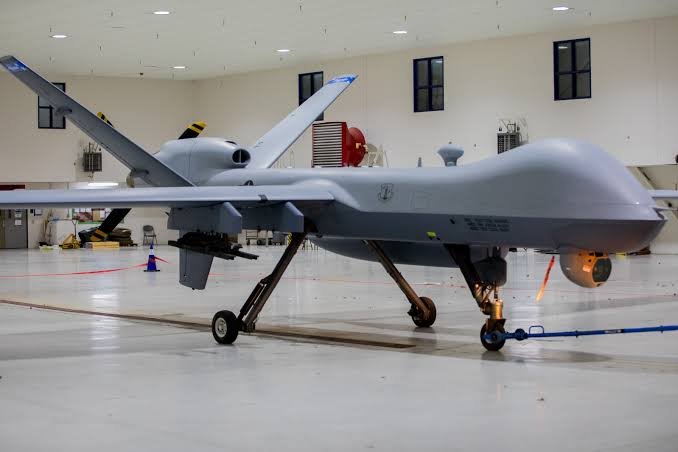
The use of unmanned military aircraft is expanding across Africa as governments involved in armed conflicts increasingly turn to drones for surveillance, intelligence gathering and battlefield strikes.
New figures covering the period from 2022 to 2025 show that the Democratic Republic of Congo (DR Congo), Sudan and Mali were the continent’s biggest recipients of major military drones from foreign suppliers.
DR Congo ranked first in Africa after receiving 29 military drones, while Sudan followed with 17 and Mali recorded 15. The figures are based on an analysis of data from the Stockholm International Peace Research Institute (SIPRI).
Despite the growing role of drones in African conflicts, the continent accounted for only a small portion of the global trade during the four-year period.
DR Congo leads African imports
DR Congo’s position at the top of the African ranking reflects the growing importance of air power in its long-running conflict in the eastern part of the country.
The Congolese military has used Chinese-made CH-4 Rainbow unmanned aircraft in operations against M23 rebels and other armed groups.
The country’s 29 imported systems placed it 12th globally, behind major recipients such as Ukraine and Russia.
Sudan came second in Africa with 17 imported drones. The country’s prolonged civil war has increasingly featured unmanned aircraft, with both sides using drones as the conflict has developed.
Mali ranked third with 15 systems. The West African country has expanded its use of combat drones as its military confronts jihadist and separatist groups.
Turkish-made aircraft have become particularly important in Mali, including the Bayraktar TB2 and the larger Akıncı platform.
Other African countries also expanding drone capabilities
The growth is not limited to the three leading importers.
Burkina Faso and Morocco each recorded 10 major military drones between 2022 and 2025. Niger and Nigeria received seven each, while Algeria and Kenya recorded six apiece.
Combined, the nine African countries identified in the ranking imported 107 major military drones during the period.
That figure represents only a small proportion of the 16,822 major military drones recorded as imported worldwide.
The numbers also do not capture the full scale of drone use on the continent because many smaller systems are outside SIPRI’s classification.
Ukraine and Russia dominate global drone trade
The global figures show just how heavily the Russia-Ukraine war has influenced military drone transfers.
Ukraine received 8,664 drones from foreign suppliers between 2022 and 2025, accounting for about 51.5 per cent of the worldwide total.
Russia was second with 6,720, representing nearly 40 per cent.
Together, the two countries accounted for more than 91 per cent of all recorded major military drone imports during the period.
The United States was a major supplier to Ukraine, providing about 83 per cent of the country’s recorded imported systems.
Russia, meanwhile, initially relied heavily on Iranian-made Shahed-136 drones before developing and expanding domestic production of its Geran-2 variant.
China and Türkiye strengthen their presence in Africa
While the United States and Iran have played major roles in supplying opposing sides in the Russia-Ukraine conflict, China and Türkiye have emerged as important suppliers to African countries.
Chinese technology has featured prominently in DR Congo’s drone fleet, while Turkish systems have become increasingly visible in countries such as Sudan and Mali.
The trend highlights how competition in the international defence industry is extending beyond traditional weapons such as aircraft, tanks and artillery.
Drones offer governments a way to conduct surveillance and launch attacks without necessarily putting large numbers of pilots or ground troops directly in harm’s way.
The figures tell only part of the story
The actual number of drones operating in conflicts worldwide is considerably higher than the SIPRI figures suggest.
SIPRI’s database focuses on major weapons, including unmanned aircraft weighing at least 150kg when loaded. It also counts certain one-way attack drones and loitering munitions.
Smaller first-person-view (FPV) drones and many commercially available unmanned aircraft are generally excluded.
This distinction is important because relatively inexpensive commercial and FPV drones have become increasingly common on African battlefields.
Consequently, the 107 major drones imported by the nine African countries should not be interpreted as representing the continent’s entire military drone inventory.
Drone warfare becoming more important in Africa
The growing acquisition of unmanned systems points to a wider transformation in African military operations.
In conflict zones such as eastern DR Congo, Sudan and the Sahel, drones are increasingly being used to locate targets, monitor territory and support offensive operations.
The trend also illustrates Africa’s growing dependence on foreign defence technology as governments seek new tools to respond to insurgencies and internal conflicts.
As drone technology becomes cheaper and more widely available, African militaries are likely to continue expanding their unmanned capabilities.
For countries facing persistent security threats, the attraction is clear: drones can provide battlefield intelligence and strike capacity while changing how military forces operate.
The rapid development of drone warfare could therefore become an increasingly important feature of Africa’s security landscape in the years ahead.