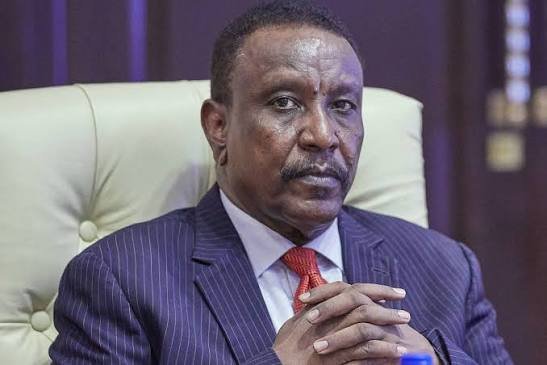
Sudanese pro-democracy figure Yasir Arman has cautioned the country’s military leadership against using recent battlefield successes as a pathway for bringing the former Islamist political order back to power.
Arman, a prominent civilian political figure, said restoring the influence of Islamist forces would risk prolonging Sudan’s conflict and could further destabilise a country already facing one of the world’s most severe humanitarian crises.
He made the remarks during a discussion at Chatham House in London, where he reflected on the roots of Sudan’s war and the challenges facing efforts to return the country to civilian rule.
Arman Opposes Return of Former Islamist Regime
According to Arman, military advances by the Sudanese Armed Forces (SAF) should not be interpreted as an opportunity to revive the political system associated with the country’s former Islamist leadership.
He argued that battlefield victories alone cannot address the political and structural problems that contributed to the conflict.
The pro-democracy campaigner warned that allowing Islamist forces to regain significant influence over the state could deepen political divisions and increase the militarisation of government institutions.
In his assessment, such a development could push Sudan into another prolonged period of violence instead of creating the conditions needed for lasting peace.
Arman also accused Islamist elements of contributing to the collapse of Sudan’s democratic transition, particularly following the military takeover of October 2021.
Sudan War Rooted in Political Crisis
Sudan has been engulfed in war since April 2023, when fighting erupted between the SAF and the paramilitary Rapid Support Forces (RSF).
The conflict has killed large numbers of people, displaced millions and devastated infrastructure across the country.
Arman argued that the current crisis should not be viewed simply as a contest between two armed organisations.
He said the conflict was also connected to deeper failures in Sudan’s state-building process and the repeated exclusion of civilians from political decision-making.
The former political environment, he argued, created conditions in which security institutions became heavily involved in politics, making a return to genuine civilian government increasingly difficult.
Neither Military Camp Has Democratic Mandate
Arman also challenged the idea that either side of the current conflict possesses a legitimate mandate to determine Sudan’s political future.
He maintained that both the SAF and RSF had undermined the democratic transition that followed the 2018 revolution.
The pro-democracy leader said civilians should ultimately have the authority to determine the country’s political direction rather than leaving the future of Sudan in the hands of competing military formations.
His position comes as the SAF has made significant territorial gains in parts of the country while fighting against the RSF continues in other regions.
Despite those military developments, Arman argued that victory on the battlefield would not by itself resolve Sudan’s political crisis.
Humanitarian Situation Remains Critical
Beyond the political struggle, Arman highlighted the enormous humanitarian consequences of the war.
More than 25 million people are affected by the crisis, while hunger and displacement continue to threaten communities across Sudan.
He identified areas including Al Gezira, Kordofan and Darfur as particularly vulnerable to worsening food insecurity.
The prolonged conflict has also contributed to economic instability, inflation and the expansion of networks benefiting from wartime corruption.
For millions of Sudanese, the political dispute has therefore become a daily struggle for food, safety and access to basic services.
Call for Immediate Humanitarian Ceasefire
Arman called on the international community to increase pressure for an immediate humanitarian ceasefire.
He urged the United Nations Security Council to support a proposal from the African Peace and Security Council for a ceasefire backed by an international monitoring mission.
He also called for international support for the Quartet’s roadmap for resolving the conflict.
The proposal reflects growing pressure on international and regional actors to move beyond statements of concern and develop mechanisms capable of stopping the fighting and facilitating humanitarian access.
Dialogue Should Include Sudanese Civilians
Arman further proposed direct negotiations between the Sudanese army and representatives of the anti-war civilian movement.
He said such discussions should initially take place on neutral territory before eventually bringing the RSF into a broader political process.
The ultimate objective, according to Arman, should be the dismantling of competing militias and the creation of a unified national army operating under civilian authority.
Such a restructuring would represent a major departure from Sudan’s history of military involvement in politics.
Sudan’s Difficult Path to Peace
The remarks underline the complicated political choices facing Sudan as the war enters another phase.
Military gains by one side may change the balance of power, but they do not necessarily address the grievances, institutional weaknesses and political divisions that have fuelled instability for years.
For Arman, any peace agreement that simply replaces one armed political order with another would fail to solve Sudan’s underlying problems.
He argued that the country requires a fundamental political transformation rather than a return to authoritarian rule.
As diplomatic efforts continue and fighting persists in several parts of Sudan, the central challenge remains finding a settlement that ends the war while giving civilians a meaningful role in rebuilding the country’s political institutions.
The debate over the role of the military, Islamist groups and civilian forces is therefore likely to remain at the heart of Sudan’s search for a lasting peace.