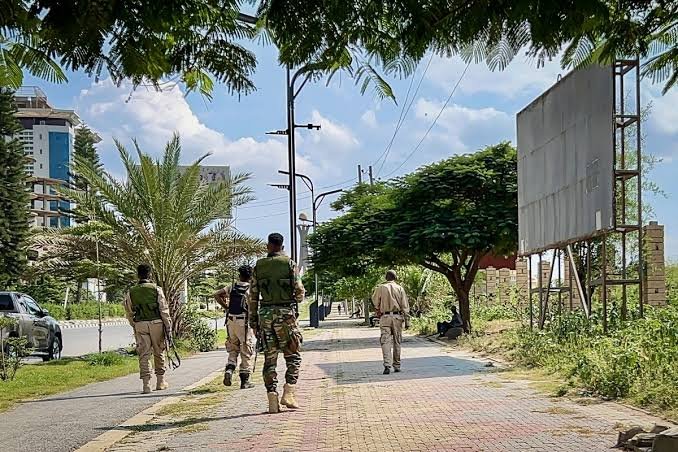
Fresh fighting has erupted in northern Ethiopia, raising concerns that the country could be heading back toward a wider armed conflict less than four years after a peace agreement ended the devastating Tigray war.
Fighters aligned with the Tigray People’s Liberation Front (TPLF) launched attacks on government positions on Wednesday and took control of several airports in the Tigray region, according to reports from the area.
The renewed violence comes days after the TPLF joined six other armed groups in forming a new alliance that has declared its intention to remove Prime Minister Abiy Ahmed’s government.
Tigray rebels and government trade accusations
The latest clashes have been accompanied by conflicting accounts from the two sides over who began the escalation.
The Tigray forces said their attacks were a response to what they described as a broad government military offensive involving ground troops, mechanised units, drones and aircraft.
Ethiopian authorities, however, have accused the TPLF of launching a major offensive against federal positions in the neighbouring Afar and Amhara regions.
The competing claims have made it difficult to independently establish the sequence of events as fighting continues.
Reports indicate that Tigrayan fighters gained control of airports in the region, while clashes were also reported in parts of Afar. Ethiopian Airlines suspended flights to three airports in Tigray as the security situation deteriorated.
Memories of the 2020-2022 war
The latest developments have revived memories of Ethiopia’s previous Tigray conflict, which lasted from 2020 to 2022 and caused enormous loss of life and displacement.
The war ended with the signing of the Pretoria peace agreement in November 2022. Although the accord reduced large-scale fighting, several political and security disputes remained unresolved.
Analysts now fear that the fragile post-war arrangement is under severe pressure.
Hassan Khannenje, director of the HORN International Institute for Strategic Studies, described the situation as a return to the kind of confrontation seen after the Pretoria agreement, according to The Washington Post.
The Tigray region has also struggled to recover from the earlier conflict, with significant numbers of residents still displaced and several aspects of the peace agreement yet to be fully implemented.
New alliance brings former enemies together
The renewed fighting follows the creation of the Ethiopian Peoples’ Forces Alliance for Survival.
Seven armed groups announced the coalition on Sunday, bringing together factions that have previously fought one another.
Among them are the TPLF, the Amhara Fano National Movement and the Oromo Liberation Army. The coalition also includes the Ogaden National Liberation Front, Afar Revolutionary Democratic Unity Front, Benishangul Peoples’ Liberation Movement and Gumuz Peoples’ Democratic Movement.
The alliance has accused Abiy’s administration of centralising power and failing to address political and security grievances across the country. Its stated objective is to remove the current government.
The Ethiopian government has accused the coalition of receiving support from Eritrea, although Eritrea has repeatedly rejected such allegations.
Concern grows over civilian impact
The renewed fighting has created fresh anxiety among civilians in Tigray.
Residents have reported concerns over disruptions to transportation and telecommunications, while some families have begun storing food amid fears that the conflict could worsen.
Tesfaye Hailay, a resident who had previously fled Ethiopia during the earlier war, told The Washington Post that many people were worried about the possibility of being forced to leave again. He also said economic hardship left many households with little capacity to cope with another conflict.
The humanitarian consequences could be significant if fighting spreads beyond the current areas of confrontation.
Tigray was already dealing with the effects of the previous war, including displacement and damaged infrastructure. A prolonged conflict could further complicate recovery efforts and increase pressure on civilians.
US urges dialogue
The United States has expressed concern over the escalation and urged the parties involved to return to dialogue.
Washington called on the Ethiopian government and opposing forces to engage constructively in order to prevent the violence from expanding.
The US ambassador to Ethiopia also criticised the decision by TPLF leaders to pursue renewed military confrontation, arguing that dialogue offered a better route for resolving political differences.
The renewed violence is also unfolding against a complicated regional backdrop.
Ethiopia has unresolved tensions with Eritrea, while disputes over access to the Red Sea have added another layer to the country’s security challenges. At the same time, Ethiopia has been affected by conflicts involving armed groups in regions including Amhara and Oromia.
Ethiopia faces uncertain security outlook
The immediate trajectory of the latest clashes remains unclear.
The presence of several armed groups with different political and territorial interests could make cooperation within the new alliance difficult. Analysts have also pointed to geographical distance and differences among the groups as potential obstacles to sustained joint operations.
For civilians in Tigray and other conflict-affected areas, however, the immediate concern is the possibility of another prolonged confrontation.
With fighting already reported and the Pretoria agreement under growing strain, renewed diplomatic engagement could become increasingly important in preventing the latest clashes from developing into another major Ethiopian war.