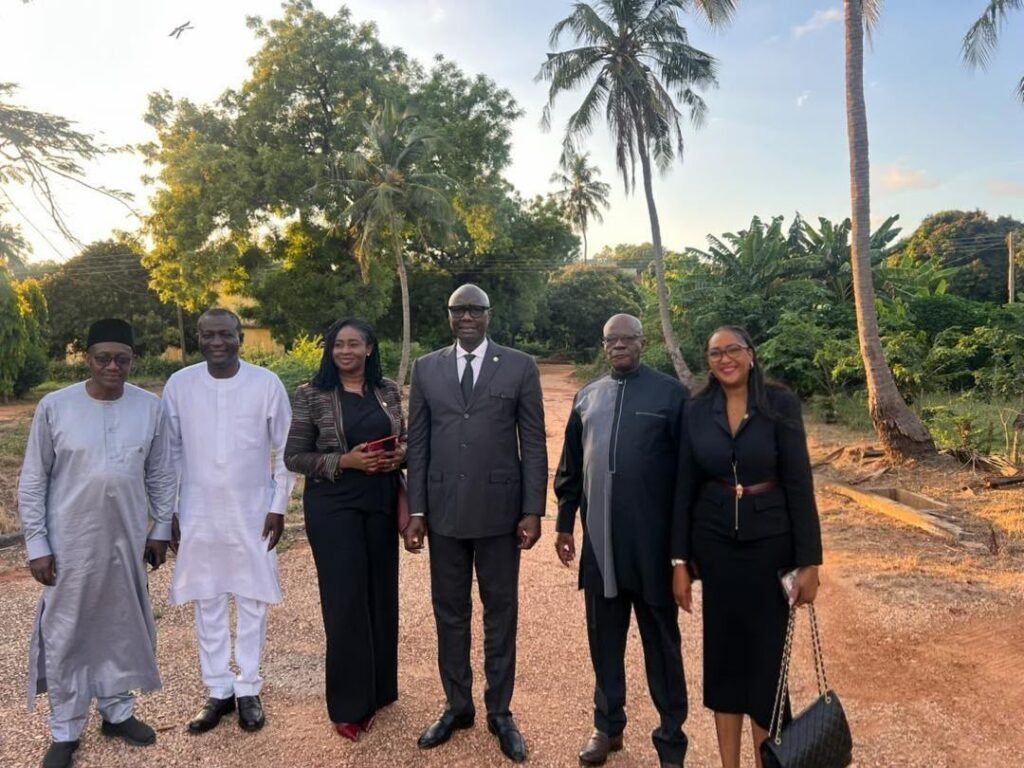
Ghana has allocated land in Accra for a permanent headquarters of the ECOWAS Regional Electricity Regulatory Authority, marking a new step in the regional body’s plans to strengthen electricity regulation across West Africa. The decision followed talks on November 11 between Ghanaian President John Dramani Mahama and General Birame Diop, president of the ECOWAS Commission, the regional organisation said. Diop later visited the site earmarked for the project.
The land allocation is intended to enable construction of a permanent base for ERERA, a specialised ECOWAS institution. The organisation has not announced a construction timetable, budget, contractor or design details. The site visit signals progress on establishing the facility, but the information released so far does not indicate when building work will begin or when the authority might move in.
ERERA’s work concerns the regulation of electricity exchanges between ECOWAS member states and the development of a more integrated regional power market. Its responsibilities include supporting national electricity regulators, helping establish transparent methods for setting regional electricity tariffs, overseeing cross-border power trade and addressing regulatory issues that arise between market participants.
The authority is already based in Accra, where it operates from offices in the Energy Commission Building and an annex in the Airport Residential Area. The new land allocation therefore supports a purpose-built, permanent headquarters rather than the initial establishment of an Accra presence. ECOWAS says a dedicated facility is expected to improve the authority’s institutional and operational capacity.
The project’s importance extends beyond a new office. West African countries share electricity infrastructure and trade power across borders, so common rules and regulatory cooperation can affect how reliably and efficiently electricity moves between markets. ERERA is tasked with regulating interstate exchanges and helping create the conditions for a functioning regional electricity market. A stronger institutional base could support that work, although the practical impact will depend on the authority’s capacity, cooperation among national regulators and the development of cross-border connections.
Regional integration also requires regulatory clarity. Electricity trading depends on agreed technical and commercial arrangements, including pricing methods, access to transmission networks and ways to settle disputes. ERERA’s mandate includes supporting these frameworks and assisting national regulators with technical matters. Its role is to help coordinate rules for regional exchanges, while national bodies continue to regulate their own domestic electricity sectors.
Ghana’s allocation was presented by ECOWAS as a contribution to regional integration and to the strengthening of Community institutions. Hosting ERERA in Accra gives the authority a location within a member state while serving a regional mandate. The land transfer creates a basis for a dedicated headquarters project, but it does not by itself resolve the operational challenges facing electricity trade across West Africa.
Those challenges include the need for effective coordination between countries and regulators, as well as the infrastructure required to move electricity across national borders. A permanent headquarters may give the authority more suitable facilities for its staff and operations, but the broader goal is to improve the rules and institutional support governing regional electricity exchanges.
The project has been in preparation for several years. ECOWAS procurement documents published previously referred to technical studies, architectural planning, project management and construction supervision for the headquarters. That earlier preparatory work indicates that the site allocation fits within a longer project process, though the latest announcement did not specify whether previous studies are complete or provide a new construction schedule.
For Ghana, providing land reinforces its role as host country for the regional regulator. For ECOWAS, the next steps will be to move from site allocation toward financing, design and construction, while continuing to build the authority’s ability to oversee cross-border electricity activity. Details on those steps have yet to be made public.
The announcement is therefore a concrete but early milestone: the government has set aside a location, and the Commission’s president has inspected it. The headquarters project will be judged by what follows, including whether construction proceeds and whether the facility helps ERERA carry out its mandate. ECOWAS has framed the development as part of a wider effort to strengthen regional institutions and advance energy integration in West Africa.