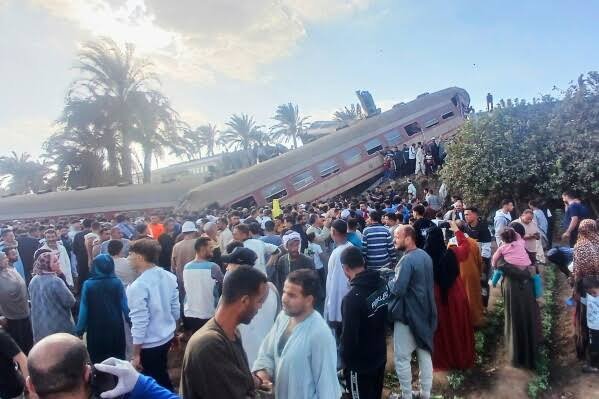
At least seven people have been killed and more than 100 others injured after two passenger trains collided in Egypt’s Giza Governorate, south of Cairo, in one of the country’s latest major railway accidents.
The crash happened on Sunday, November 8, 2026, in the Al-Ayyat district, approximately 52 kilometres south of Cairo. The collision caused several train carriages to derail, leaving passengers trapped and prompting an extensive emergency response.
Egypt’s Ministry of Health initially reported four deaths and 88 injuries. The figures were subsequently revised, with later updates confirming seven fatalities and 125 injured passengers.
The accident has renewed concerns about railway safety in Egypt, where authorities have been investing in modernising the country’s extensive rail network following years of deadly crashes.
How the Giza train collision happened
According to Egypt’s National Railways Authority, the accident involved two passenger services travelling in the same direction.
Train No. 134, operating on the Giza-Fayoum route, struck the rear of train No. 2010, which was travelling from Cairo towards Aswan.
The collision occurred between Kafr Ammar and Al-Raqqa railway stations in the Al-Ayyat area. Initial findings from the site inspection indicated that the Cairo-Aswan train was stationary on the same track when it was hit from behind.
The impact caused several carriages to derail, damaging parts of the trains and creating difficult conditions for passengers and rescue workers.
Authorities deployed emergency personnel and heavy equipment to the scene to remove damaged carriages and clear the railway line.
The exact technical circumstances that led to the collision remain under investigation.
Death toll rises as injured passengers receive treatment
Egypt’s Ministry of Health and Population confirmed that seven people died in the incident, while the number of injured passengers eventually reached 125.
The casualties were taken to hospitals in Giza and neighbouring Beni Suef Governorate, where medical teams provided emergency treatment.
Seventy-two ambulances participated in evacuation operations, transporting injured passengers to several healthcare facilities.
According to updates published by Ahram Online, Al-Wasta Central Hospital received 87 casualties, including three fatalities. El-Ayyat Central Hospital treated 34 injured passengers, while Atfih Central Hospital received 11 cases, including four deaths.
Many of the injured suffered fractures, cuts, bruises and other trauma-related injuries.
More than 70 patients were discharged after receiving treatment and showing signs of improvement, while others remained in hospital for further medical attention and observation.
The Health Ministry said it was monitoring the situation and had instructed medical facilities in Giza and Beni Suef to maintain emergency readiness.
President Sisi orders investigation into the accident
Egyptian President Abdel Fattah el-Sisi expressed condolences to the families of those killed and wished injured passengers a quick recovery.
He also instructed relevant government agencies to ensure that victims received the necessary medical assistance and ordered a prompt investigation into the circumstances surrounding the collision.
The president said anyone found responsible for negligence should be held accountable.
Egypt’s Public Prosecution opened an investigation to establish the technical causes of the accident and determine whether operational failures or breaches of railway safety procedures contributed to the disaster.
Investigators visited the crash site and hospitals, while a specialised technical committee was assigned to examine the damaged carriages, railway tracks and other relevant equipment.
The committee is expected to assess the sequence of events leading to the collision and identify any shortcomings in railway operations.
The findings could help determine whether the accident resulted from equipment failure, signalling problems, human error or other operational issues. No final cause had been established in the initial reports.
Railway services disrupted after collision
The crash disrupted train operations along an important section of Egypt’s railway network connecting Cairo with destinations in Upper Egypt.
Rescue teams and railway workers began removing wreckage and damaged carriages to restore normal services.
The Transport Ministry also arranged alternative bus transportation for passengers affected by the disruption.
Buses were deployed between Al-Wasta and El-Ayyat stations, as well as along routes connecting El-Moneib and El-Ayyat, while railway operations were being restored.
The disruption affected passengers travelling between the capital and southern parts of the country, highlighting the importance of the railway corridor for domestic transportation.
Authorities said efforts were underway to clear the tracks and resume services as quickly as possible.
Compensation for victims and their families
Egypt’s Financial Regulatory Authority also announced steps to accelerate compensation payments for victims of the collision.
The Railway and Metro Accident Insurance Pool was directed to contact affected families and speed up the process of providing financial assistance.
According to Ahram Online, compensation for deaths and permanent total disability was increased from 30,000 Egyptian pounds to 50,000 Egyptian pounds.
The move was intended to provide support to families who lost relatives and passengers who suffered serious injuries.
Egypt’s history of railway accidents
The latest collision has brought renewed attention to safety challenges facing Egypt’s railway system.
The country operates one of the oldest and largest railway networks in the Middle East and North Africa. It is an important transportation system for millions of passengers travelling between Cairo, the Nile Delta and southern governorates.
However, the network has experienced repeated accidents involving collisions, derailments and equipment failures.
One of the country’s worst railway disasters occurred in 2002, when a fire swept through an overcrowded passenger train travelling from Cairo towards southern Egypt. More than 300 people were killed, making it one of the deadliest rail accidents in the country’s history.
Other incidents have also occurred in recent years. In September 2026, two freight trains collided in Giza’s El-Ayyat district, injuring a train driver and his assistant and causing a locomotive and two wagons to derail.
Egypt has announced major investments in railway infrastructure, signalling systems, rolling stock and operational improvements. Ahram Online reported that the country’s railway development programme involved investments estimated at approximately 366 billion Egyptian pounds.
Despite these efforts, the latest disaster demonstrates the continuing importance of effective safety enforcement, equipment maintenance and reliable railway operations.
Investigation expected to establish responsibility
The immediate priority for Egyptian authorities remains the treatment of injured passengers, support for victims’ families and restoration of disrupted railway services.
The Public Prosecution’s investigation will also be important in establishing how a train travelling from Giza to Fayoum collided with the rear of another service on the same track.
The final findings are expected to clarify whether operational mistakes, technical problems or failures to follow safety procedures contributed to the crash.
For the families of the seven people killed and the injured passengers, the immediate consequences are already severe. The investigation will now determine whether the tragedy could have been prevented and what measures are necessary to reduce the risk of similar accidents in the future.