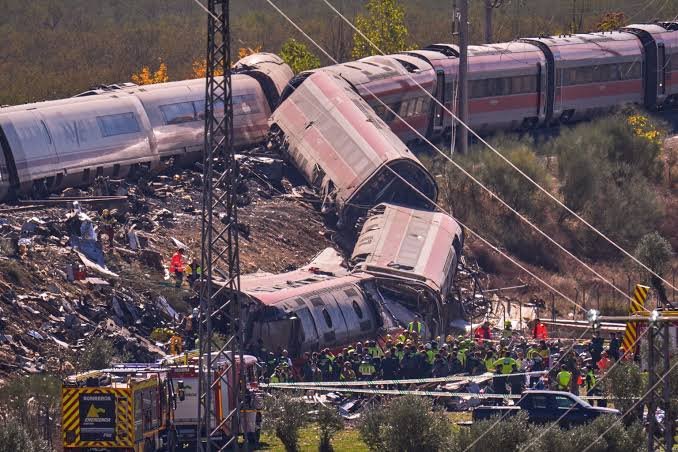
At least 69 people have died following a devastating train collision in central Spain, with authorities confirming that 12 of the victims were foreign nationals as forensic teams continue efforts to identify everyone killed in the disaster.
The accident happened on Wednesday, October 28, near Urda in Toledo province, approximately 130 kilometres south of Madrid. It involved a train operated by Spain’s state-owned railway company, Renfe, and another service belonging to private operator Iryo.
Spanish authorities said 66 of the 69 victims had been formally identified as of November 2. The confirmed identities include 54 Spanish citizens and 12 foreign nationals from nine countries.
The latest identifications have brought the international death toll into clearer focus, while families of missing passengers continue to wait for official confirmation.
US Citizens Among Foreign Victims
Four American citizens were among the foreign nationals confirmed dead in the collision. The other identified international victims include one citizen each from Argentina, Canada, the Czech Republic, France, Japan, Mexico, Portugal and Tunisia.
The three remaining victims had not been formally identified at the time of the latest update. Authorities believe they are also foreign nationals, with outstanding missing-person reports involving two Australians and one Japanese citizen.
Spanish officials said the families of the three missing individuals had been contacted and expressed a desire to travel to the country to take part in the identification process.
The authorities are awaiting their arrival before completing the necessary procedures.
The tragedy has caused distress beyond Spain, particularly among families and communities in the countries whose citizens were aboard the trains.
Forensic Teams Continue Identification Exercise
Forensic specialists have been working continuously at facilities in Toledo and Ciudad Real to identify those who died.
According to information released by the judicial authorities in Castilla-La Mancha, 53 of the 66 identified victims were confirmed through fingerprint analysis conducted by the Guardia Civil’s forensic specialists.
The remaining 13 identifications were completed through DNA testing carried out by Spain’s National Institute of Toxicology in cooperation with the Guardia Civil.
The process has involved more than 60 forensic and support professionals, including medical examiners, autopsy technicians and DNA specialists.
Authorities also confirmed that 60 families had received formal notification of their relatives’ deaths. The bodies of 47 victims had been released to their families as identification and administrative procedures continued.
The identification exercise has proved difficult because of the condition of some remains recovered from the wreckage. In certain cases, specialists have had to rely on DNA evidence and detailed forensic examination to establish identities.
Officials have emphasised the importance of confirming each victim’s identity before including the death in the official public record.
How the Collision Happened
The crash involved a Renfe train and an Iryo service that had stopped on the railway line. The Renfe train struck the rear of the stationary Iryo train, resulting in a major accident that killed dozens of passengers.
More than 540 people were reportedly aboard the two trains, making the collision one of Europe’s deadliest railway disasters in recent years.
Investigators are examining the circumstances surrounding the collision, including railway operations and the events that led to one train striking another that was not moving.
The disaster has renewed scrutiny of Spain’s railway safety arrangements. Questions have also emerged because the country experienced another deadly high-speed train accident in January, when a collision near Adamuz in Andalusia claimed 46 lives.
The two incidents have intensified public attention on the safety of the country’s rail network, which is one of the largest high-speed systems in the world.
Spain Faces Renewed Railway Safety Questions
The latest collision has placed railway safety under increased scrutiny, with passengers, relatives of victims and transport workers seeking answers about how the accident occurred.
The January disaster and the October collision have raised concerns about the reliability of railway operations and the measures available to prevent serious accidents.
However, the investigation into the Urda collision remains ongoing, and authorities have yet to establish a complete account of the circumstances that led to the tragedy.
For the families affected, the immediate priority remains identifying missing relatives, receiving the bodies of loved ones and obtaining answers about the disaster.
The Spanish government and relevant authorities are expected to face continued pressure to explain what happened and identify any shortcomings that may have contributed to the collision.
As forensic work continues, the confirmed death toll remains at 69, with 66 victims identified. The remaining three cases are awaiting further examination and the arrival of relatives who wish to assist with the identification process.
The tragedy has left families across Spain and several other countries mourning their loved ones, while the investigation is expected to play a central role in determining what went wrong and whether further railway safety measures are needed.