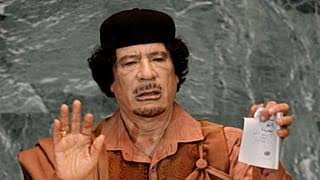
Fifteen years after the death of former Libyan leader Muammar Gaddafi, his influence continues to spark debate across Libya and other parts of Africa. While some remember his government for its oil-funded development programmes and support for African liberation movements, others recall decades of authoritarian rule, political repression and restrictions on dissent.
Gaddafi was killed on October 20, 2011, after a popular uprising against his government developed into an armed conflict, followed by international military intervention. His removal ended more than four decades of rule but did not bring the stable political transition many Libyans had hoped for.
Instead, Libya has experienced prolonged instability, competing political authorities and the growing influence of armed groups. The country remains divided, while the consequences of the 2011 conflict have extended into neighbouring states, particularly across the Sahel.
A recent analysis by Radio France Internationale (RFI), featuring Libya specialist Virginie Collombier of Rome’s Luiss Guido Carli University, examines how Gaddafi’s political ideas and historical reputation continue to influence debates about Libya’s future and Africa’s wider security challenges.
The Political Ideas Behind Gaddafi’s Rule
Gaddafi seized power in a military coup in 1969 and developed a political system that he presented as an alternative to both Western capitalism and Soviet-style communism.
His ideology was outlined in the Green Book, which promoted a model of direct popular participation and rejected conventional parliamentary democracy. The system, known as the Jamahiriya, was officially described as a state governed by the masses through local committees and other political structures.
In practice, however, political authority remained heavily concentrated around Gaddafi. Opposition was suppressed, independent political activity was severely restricted, and the government relied on security institutions to preserve its control.
The country’s oil wealth helped finance public services and development initiatives, giving the government significant resources. Yet those economic benefits existed alongside a political system in which citizens had limited freedom to challenge the leadership.
Collombier’s analysis suggests that Gaddafism cannot be understood through the Green Book alone. It was also shaped by Libya’s history, social structures, oil-driven transformation and years of relative isolation under international sanctions.
Why Gaddafi Built Stronger Ties With Africa
Although Gaddafi initially sought leadership within the Arab world, his relationships with several Arab governments became strained. His ambitions to influence regional politics, alongside disagreements with other leaders, pushed him to place greater emphasis on Africa.
He presented himself as an advocate for African independence, economic cooperation and resistance to foreign domination. His government supported liberation movements, including the African National Congress during its struggle against apartheid in South Africa, and invested in initiatives intended to strengthen ties with African countries.
Nelson Mandela visited Gaddafi in 1990 to express appreciation for Libya’s support for the anti-apartheid struggle. That history remains an important part of the former Libyan leader’s standing among some African political figures.
His reputation across the continent, however, was never uniform. Some leaders viewed him as a source of financial assistance and a supporter of African autonomy, while others were wary of his political ambitions and involvement in conflicts beyond Libya’s borders.
Today, nostalgia for Gaddafi is particularly visible among people who believe African countries remain too dependent on outside powers. But his supporters’ positive assessment of his international role often sits uneasily alongside the record of repression under his government.
Did His Fall Destabilise the Sahel?
One of the most persistent arguments surrounding Gaddafi’s legacy concerns the consequences of the 2011 intervention that helped bring down his government.
After his regime collapsed, Libya’s security institutions fragmented and weapons spread across the region. Fighters and military equipment moved through porous borders, contributing to insecurity in countries already facing political and social tensions.
The Sahel subsequently experienced expanding militant activity, armed rebellions and instability. Gaddafi’s removal is not the sole explanation for these developments, which have multiple historical and political causes. Nevertheless, some analysts argue that the collapse of the Libyan state intensified existing problems by weakening border security and allowing armed groups to access more weapons.
Critics of the intervention also question whether the countries involved had a credible plan for rebuilding Libya after the military campaign. The absence of an effective, unified state created conditions in which rival factions could compete for territory, institutions and economic resources.
These concerns have strengthened resentment among some African observers who believe the operation focused on removing Gaddafi without adequately preparing for the political consequences.
The debate remains contentious: opponents of the former leader point to his authoritarian rule, while critics of the intervention emphasise the long-term damage caused by the collapse of state institutions.
Why Gaddafi Loyalists Have Struggled to Return
Despite continued nostalgia among some Libyans, the political movement associated with Gaddafi has failed to re-establish itself as a dominant national force.
The 2011 uprising was not simply a change of leadership. It developed into a civil war involving competing armed groups, rival political interests and foreign intervention. Following the regime’s collapse, former loyalists were marginalised, while new centres of power emerged.
Over time, some figures who served under Gaddafi found ways to return to public life by aligning themselves with influential political or military factions. Others remained outside the emerging power structures and continued to look for a political alternative.
Saif al-Islam Gaddafi, Muammar Gaddafi’s son, became a potential rallying figure for supporters of the former regime. His political appeal drew partly on public frustration with Libya’s prolonged divisions and the failure to establish a stable national government.
However, Saif al-Islam was killed in February 2026, according to reports, dealing a serious blow to a movement that lacked a clear alternative leader. His death also renewed questions about political violence, accountability and whether Libya can develop a system in which competing groups pursue power without resorting to force.
Libya’s Unfinished Political Transition
Fifteen years after Gaddafi’s death, Libya continues to face a difficult task: building a unified state capable of delivering security, justice and dependable public services.
Rival political authorities and armed groups retain significant influence, while efforts to organise national elections have repeatedly stalled. The country’s oil resources remain central to its economy, but disagreements over political authority and the distribution of wealth continue to complicate governance.
The persistence of these problems has made assessments of the Gaddafi era more complicated. For some people, the former government represents a period of greater order and state capacity. For others, memories of repression and the absence of political freedom make a return to that system unacceptable.
Neither perspective resolves the central challenge facing Libya today. Stability requires more than nostalgia for the past or the removal of a former leader. It depends on credible institutions, political participation, accountability and an agreement on how national resources should be managed.
Gaddafi’s legacy therefore extends beyond the memory of one ruler. It encompasses the consequences of authoritarian government, the risks of state collapse and the continuing struggle to build a political order that can command public confidence.
As Libya and its neighbours reflect on the fifteen years since 2011, the central question remains whether the country can overcome its divisions and establish lasting peace without repeating the abuses or instability that have defined its recent history.