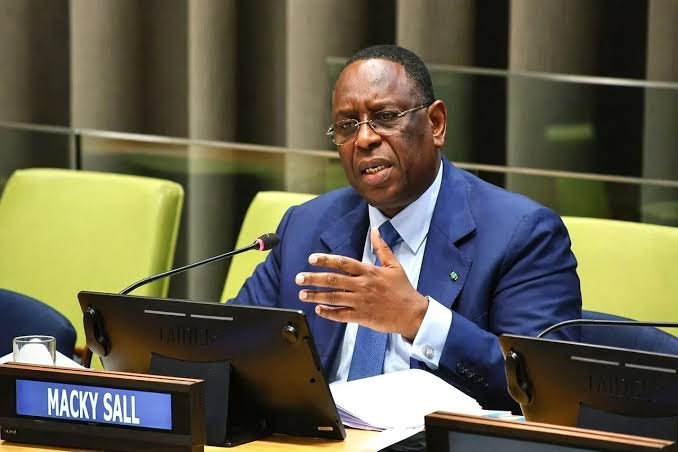
Former Senegalese President Macky Sall has withdrawn his candidacy for the position of United Nations secretary-general, ending his bid to lead the international organisation after a series of informal votes exposed difficulties in securing sufficient support.
Sall announced his decision on Saturday, October 17, 2026, a day after members of the UN Security Council conducted another informal poll involving seven candidates seeking to succeed outgoing Secretary-General António Guterres.
The former Senegalese leader said he hoped his withdrawal would help the council reach agreement on a candidate capable of attracting broader support.
His decision comes amid growing diplomatic attention surrounding the selection process, including debates over regional representation, the possibility of appointing a woman to the position and the influence of the Security Council’s five permanent members.
Sall announced his decision in a statement shared on social media after the latest round of voting.
Macky Sall Steps Aside to Help Find a Consensus Candidate
In explaining his decision, Sall said the results of the informal voting process had influenced his assessment of the race. He expressed hope that withdrawing would create room for a candidate capable of attracting wider agreement within the Security Council.
The former president also pointed to indications that council members were leaning towards a candidate from Latin America and the Caribbean, potentially a woman.
His announcement followed consultations with Burundi’s President Évariste Ndayishimiye, who had sponsored his candidacy, and Senegalese President Bassirou Diomaye Faye, who had subsequently backed his bid.
Sall thanked both leaders, along with Security Council members who supported him, his campaign team and others who had encouraged his candidacy.
Although he is leaving the contest, the former president said he remained committed to the principles behind his campaign, including peace, security, economic and social development, international cooperation and dialogue between nations.
His withdrawal represents a significant development in the contest to choose the next leader of the United Nations, an organisation facing mounting international challenges and calls for institutional reform.
Security Council Poll Exposes Challenges for Candidates
Sall’s exit followed an informal Security Council poll on Friday, October 16, in which all seven candidates received at least one “discourage” vote from a permanent member, effectively signalling a veto.
The five permanent members are the United States, the United Kingdom, France, China and Russia. Each holds veto power in the process of recommending a candidate for secretary-general.
Under the selection rules, a candidate needs at least nine votes in favour from the council’s 15 members and must avoid a veto from any of the five permanent members.
The latest poll demonstrated the difficulty facing candidates who may attract support from several countries but still encounter opposition from one or more of the powerful permanent members.
Sall’s prospects had already encountered difficulties in earlier rounds. In the first informal poll in July, he received six votes in favour, seven against and two abstentions.
The Associated Press subsequently reported that Sall received 10 “discourage” votes in the October 16 poll, placing him among the candidates facing substantial opposition. The voting is conducted privately, and individual countries’ choices are not publicly identified.
The latest results have left the selection process open, with further rounds expected as Security Council members continue considering the candidates.
Rebeca Grynspan Remains Among the Leading Contenders
Following Sall’s withdrawal, Costa Rican candidate Rebeca Grynspan remained one of the leading figures in the contest.
Grynspan, a former vice-president of Costa Rica and the current head of the UN Conference on Trade and Development, received seven positive votes in the poll, alongside five votes against her candidacy.
The Associated Press reported that she received nine “encourage” votes in the latest poll, while also attracting opposition from permanent members. The different figures reflect discrepancies between the reports, so the precise tally should be checked against subsequent official or independently confirmed reporting.
Other candidates in the race include Rafael Grossi of Argentina, who heads the International Atomic Energy Agency, and Guyana’s Carolyn Rodrigues-Birkett.
The wider field also includes Ecuadorian candidates María Fernanda Espinosa and Ivonne A-Baki, as well as former Ugandan diplomat Olara Otunnu.
Sall’s departure leaves Otunnu as the only remaining African candidate in the reported field.
Debate Over Regional Rotation and African Representation
The contest has also revived discussion about the informal convention of rotating the secretary-general position among different regions.
Under this longstanding diplomatic practice, Latin America and the Caribbean are widely considered next in line to produce the UN’s top official. The arrangement is a convention rather than a binding rule, but it can influence diplomatic negotiations and the level of support candidates receive.
There has also been growing interest in appointing a woman to lead the United Nations for the first time.
Sall’s candidacy faced controversy over the process used to secure African Union backing. His nomination was sponsored by Burundi, but questions emerged over whether the African Union had properly followed its procedures for endorsing candidates.
Several member states reportedly raised concerns about the process, including Nigeria, which argued that the region should respect the established rotation principle and questioned the procedures used to promote Sall’s candidacy.
Senegal initially did not back his nomination. President Bassirou Diomaye Faye later expressed support for Sall in July, following a meeting between the two leaders.
The controversy illustrated the difficulty of securing a unified African position on an international appointment when member states disagree over procedure, regional priorities and the candidate concerned.
What Happens Next in the Race for UN Secretary-General?
Sall’s withdrawal clears one candidate from a contest that remains unresolved. The Security Council must still identify a nominee who can secure the required support while avoiding opposition from any of the five permanent members.
The next secretary-general will succeed António Guterres, whose second five-year term is scheduled to end on December 31, 2026.
The person selected will take charge of an organisation confronting armed conflicts, international rivalries, humanitarian emergencies and demands for changes to the way global institutions operate.
Sall’s decision to step aside in favour of a possible consensus candidate may help the council narrow its options, although it does not guarantee that members will quickly agree on a successor.
For Africa, his withdrawal also changes the region’s position in the contest, leaving Uganda’s Olara Otunnu as its sole candidate among the seven reported contenders.
The coming rounds of informal voting are expected to provide further indications of which candidates can attract the necessary international backing. Until a nominee emerges, the race to lead the United Nations remains open.