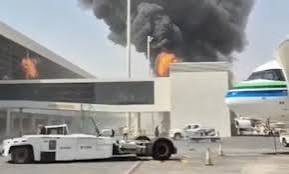
US President Donald Trump has condemned Yemen’s Houthi movement over a series of attacks on Saudi Arabia, as missile and drone strikes disrupt air travel and heighten fears of a wider regional conflict.
The escalating violence has forced Saudi authorities to extend the suspension of operations at King Khalid International Airport in Riyadh until Saturday, October 17, 2026. The closure follows repeated attacks attributed to the Iran-aligned Houthis that have caused significant casualties and raised concerns about the safety of civilian aviation.
Trump criticised the group, saying the Houthis were “misbehaving very badly”, but did not publicly confirm whether Washington would launch military action in response. His remarks came as Saudi Arabia faced growing pressure to protect its territory and restore normal airport operations.
The developments form part of a widening regional crisis connected to the war involving Iran, the United States and Israel. The latest attacks have added another dangerous front to an already volatile security situation in the Middle East.
Saudi Arabia Extends Riyadh Airport Closure
Saudi authorities have prolonged the shutdown of King Khalid International Airport as security concerns continue following a series of missile and drone attacks.
The airport, one of the kingdom’s major international aviation hubs, was closed to allow officials to complete safety checks and assess the condition of its facilities. The disruption has affected airlines operating routes to and from the Saudi capital, with several international carriers suspending services or changing their schedules.
The attacks have also raised questions about the effectiveness of Saudi Arabia’s air-defence systems. According to officials cited by the Associated Press, an investigation is examining how missiles and drones managed to reach the airport during the recent barrage.
The reported findings suggest that drones may have been used before the missile strikes, potentially complicating efforts to intercept incoming weapons. Saudi authorities have not publicly resolved all questions surrounding the incidents.
The airport shutdown is a significant disruption for a country that has invested heavily in aviation, tourism and international business. Prolonged closures could affect passenger travel, cargo movements and events planned in Riyadh.
Saudi Coalition Says Two Missiles Targeting Airbase Were Intercepted
The Saudi-led coalition has reported another attempted attack amid the worsening security situation.
Coalition spokesperson Turki al-Maliki said forces intercepted and destroyed two ballistic missiles fired by the Houthis towards Khamis Mushait airbase in southwestern Saudi Arabia, according to Al Jazeera.
The incident comes amid repeated attacks on Saudi territory, including strikes affecting airports in Riyadh and Dammam. The Houthis have claimed responsibility for several of the recent operations.
The attacks mark a serious escalation in the confrontation between the group and Saudi Arabia, which has long supported forces opposing Houthi control in Yemen.
The renewed violence also threatens to undermine regional efforts to contain the conflict. With missiles and drones increasingly targeting strategic facilities, neighbouring countries face the risk of further disruption to transport, trade and security.
Trump Weighs Possible Response to Houthi Attacks
Trump’s comments have drawn attention to the possibility of greater US involvement in the confrontation.
The US president has criticised the Houthis but has not publicly outlined a specific military response to the latest attacks. His administration faces a difficult decision over whether to intervene more directly while the broader war involving Iran continues.
Any US military action against the Houthis could expand the conflict and increase the risk of retaliation against American interests or regional partners.
The group has previously demonstrated its ability to launch missiles and drones over long distances, while its position in Yemen gives it strategic reach towards important shipping routes and neighbouring states.
For Washington, the immediate challenge is to deter further attacks without triggering an even wider confrontation. Saudi Arabia, meanwhile, must protect key infrastructure and reassure travellers and businesses that its airspace can be secured.
Neither side has publicly established what the next stage of the response will involve.
Airlines Suspend Flights as Regional Risks Grow
The security crisis has already caused substantial disruption to commercial aviation.
Qatar Airways temporarily suspended flights to and from Riyadh and Dammam, citing the regional situation. Other international airlines have also cancelled or delayed services to Saudi Arabia as they assess the risks to passengers and crews.
Reuters reported that Lufthansa had suspended Riyadh flights through October 16, while Air France-KLM extended its suspension of services to and from the Saudi capital. Etihad Airways also cancelled flights between Abu Dhabi and several Saudi cities, including Riyadh, Jeddah and Dammam. Delta Air Lines postponed the planned launch of its Atlanta–Riyadh service until March 2027.
The disruptions extend beyond individual passengers. Changes to flight schedules can affect cargo deliveries, business travel, tourism and connections between Europe, Asia and the Gulf.
Airlines may also need to reroute aircraft to avoid areas considered dangerous, adding travel time and operating costs.
The longer the security situation remains uncertain, the greater the potential impact on regional aviation and the businesses that depend on reliable international connections.
Conflict Raises Concerns Over Saudi Arabia’s Economy
The attacks are creating problems for Saudi Arabia at a time when the kingdom is seeking to attract international investment, expand tourism and diversify its economy beyond oil.
Riyadh hosts major business conferences and international events that depend on safe travel and confidence among foreign visitors. Disruption to its main airport could complicate those plans if airlines remain reluctant to operate normally.
The conflict is also contributing to uncertainty across the wider Middle East, with potential consequences for energy markets, shipping and investor confidence.
Reuters reported that the airport disruption had affected a substantial share of scheduled flights across Saudi airports. Aviation advisories from US and European authorities have also warned carriers to exercise caution when operating in the region.
The economic consequences will depend partly on how quickly airport operations can resume and whether further attacks occur.
For Saudi Arabia, restoring confidence in its aviation network is likely to be a priority alongside its efforts to strengthen air defences and prevent additional strikes.
What Happens Next?
The coming days will be important in determining whether the confrontation escalates further or moves towards containment.
Saudi authorities are investigating the recent attacks and working to establish when normal airport operations can safely resume. Airlines will continue to review their schedules according to security assessments, while governments in the region monitor the risk of additional missile and drone launches.
Trump’s next steps will also be closely watched. Although he has condemned the Houthis, the absence of a clearly announced military response leaves uncertainty over Washington’s approach.
The Houthis’ continued attacks, meanwhile, risk drawing more countries into the confrontation and prolonging disruptions to travel and commerce.
For now, the situation demonstrates how the broader war involving Iran is affecting neighbouring states far beyond the principal battlefronts. The closure of Riyadh’s airport and the suspension of flights underline the growing consequences for civilians, international travel and regional economic activity.