The director of the United States Federal Bureau of Investigation (FBI), Kash Patel, has publicly acknowledged Ghana’s contribution to an international operation targeting online scam networks after Ghanaian authorities challenged an earlier account of the mission.
The operation, known as Operation Blackout, is aimed at dismantling organised fraud centres, disrupting financial networks linked to online scams and rescuing people allegedly trafficked and forced to participate in criminal activities.
In an update published on October 11, 2026, Patel said the worldwide campaign had resulted in the seizure of approximately $17 billion, the arrest of hundreds of suspected scammers and the liberation of thousands of people believed to have been trafficked. He also reported that more than 10,000 Americans had received warnings that helped prevent an estimated $670 million in potential losses.
The statement followed criticism from Ghana’s Cyber Security Authority (CSA), which had insisted that the operation conducted in the country was organised and led by Ghanaian institutions, rather than independently directed by the FBI.
The disagreement highlighted the importance of accurately recognising the contributions of local law enforcement agencies in international investigations against cybercrime.
Ghana-Led Operation Uncovers Suspected Cybercrime Centres
Ghana’s Cyber Security Authority previously disputed the impression that the FBI had independently planned and executed the raids. The authority clarified that the exercise, also known as Operation Cyber Hunt, was organised and coordinated by Ghanaian agencies under the country’s laws, with assistance from international partners.
The operation involved several institutions, including Ghana’s National Security Council, the Criminal Investigations Department of the Ghana Police Service, the Ghana Immigration Service and the Office of the Attorney-General. International partners included the FBI, the United Kingdom’s National Crime Agency and Nigeria’s Economic and Financial Crimes Commission.
According to Ghanaian authorities, the investigation followed intelligence received on August 26, 2026, about suspected cybercrime activities at residential properties in parts of the Greater Accra Region. The locations included Ubuntu Haven Estate in Kpone Katamanso, Franko Estate in Ga North and other areas in Ga West.
Investigators suspected that some of the properties were being used as bases for organised online fraud, including romance scams.
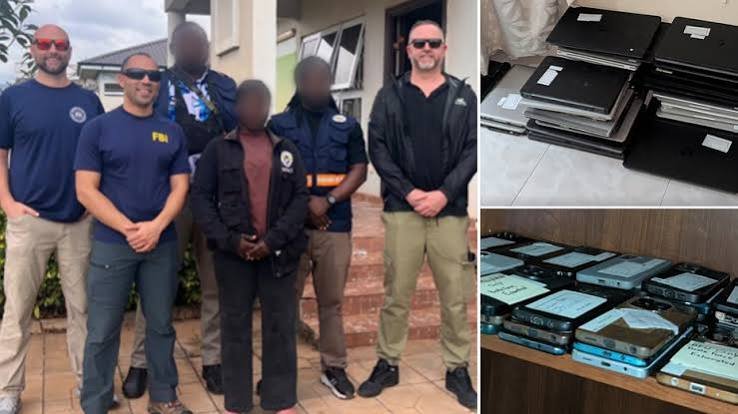
The raids led to the arrest of eight suspects and the rescue of 120 people believed to have been trafficked and exploited for online fraud. Most of those rescued were identified as Nigerians, and arrangements for their repatriation were reported to be underway.
Electronic Devices and Other Items Seized
Authorities recovered a substantial quantity of equipment and other items during the operation.
The seized materials included 136 mobile phones, 130 laptops, internet connectivity equipment and four vehicles. One of the vehicles was reportedly stolen from Canada. Investigators also recovered jewellery and 10 Nigerian passports.
The electronic devices could provide investigators with evidence about how the suspected networks operated, who was involved and whether the activities were connected to fraud targeting victims in other countries.
The investigation remained ongoing, with authorities examining the seized equipment and pursuing further inquiries into the suspects and the alleged criminal activities.
The reported figures from the Ghana operation also featured in Patel’s earlier announcement, which cited nearly $10 million in identified losses, 89 victims and more than 130 people arrested or detained. The FBI said the total included people believed to have been trafficked who would be returned to their home countries.
Ghana Emphasises Sovereignty and International Cooperation
The disagreement between Ghana and the FBI highlighted a broader issue surrounding international law enforcement operations: the need to distinguish between intelligence support and operational command.
Ghana’s Cyber Security Authority stressed that foreign agencies cannot independently exercise police powers or carry out arrests within Ghana. Their participation must take place through the appropriate legal channels and with the involvement of the country’s authorised institutions.
At the same time, the authority recognised the contributions made by the FBI and the UK’s National Crime Agency, particularly in providing intelligence to support investigations.
Ghana’s position was that cooperation with foreign partners remains essential to tackling cybercrime, but public statements should accurately describe the roles played by each participating agency.
The latest acknowledgment from Patel appears to recognise Ghana’s participation in the wider campaign following the dispute over how the Ghana operation was initially presented.
Global Fight Against Online Fraud Continues
Operation Blackout reflects the growing international effort to disrupt scam centres that allegedly use digital platforms to defraud individuals and businesses across national borders.
Such operations can involve several interconnected crimes, including online fraud, money laundering, identity theft and human trafficking. In some cases, people found inside suspected scam compounds may themselves be victims who were coerced into carrying out fraudulent activities.
The reported success of the Ghana operation therefore involves more than arrests and seized equipment. Authorities must also identify potential victims, investigate the people organising the networks and ensure that those rescued receive appropriate assistance.
With the investigation continuing, further details may emerge about the alleged fraud networks and their international connections.
For Ghana, the case also demonstrates the importance of maintaining international partnerships while ensuring that the country’s own law enforcement institutions receive appropriate recognition for operations conducted under national authority.