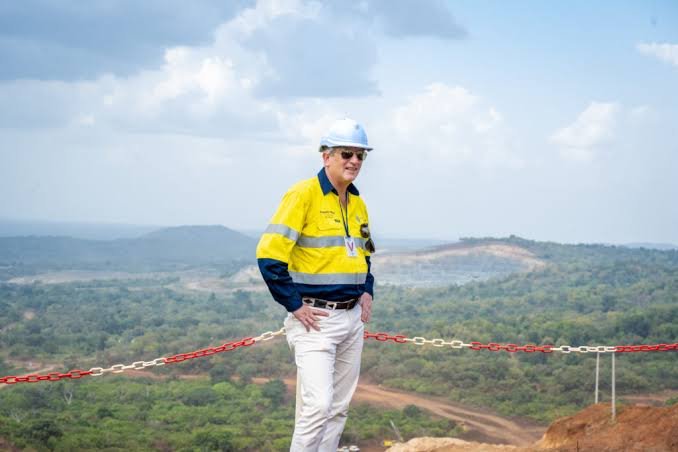
When Jorge Ganoza helped establish Fortuna Mining in 2004, the company was a small operation with just 34 employees and ambitious plans to build a name in the mining industry.
More than two decades later, those ambitions have turned Fortuna into a major mid-tier producer of gold and silver, with operations spanning two continents, more than 5,000 employees and expected revenue of over $1.5 billion in 2026.
But perhaps the biggest transformation in the company’s story has taken place thousands of kilometres away from its original Latin American base.
Fortuna has made a major push into West Africa, investing more than $2 billion in the region since 2021. The strategy has increasingly paid off, with African operations now responsible for between 56% and 60% of the company’s gold production.
Ganoza, Fortuna’s co-founder and chief executive, now expects West Africa to account for close to 80% of the company’s production once key projects in Senegal and Côte d’Ivoire reach their next stages.
From a Mining Family to Building Fortuna
Mining was already part of Ganoza’s family history. His relatives had been involved in the industry for four generations, but he eventually chose to establish a company of his own.
Trained as a geological engineer in Peru, Ganoza joined forces with Simon Ridgway and Mario Szotlender to launch Fortuna in 2004.
The company began modestly, but its founders had much bigger ambitions.
Over the years, Fortuna expanded across Latin America before making a decisive move into Africa. The company’s transformation has been significant, growing from a small mining venture into a business that now expects billions of dollars in annual revenue.
Why West Africa Caught Ganoza’s Attention
Ganoza first visited West Africa in 2015, after spending years developing Fortuna’s presence in Latin America.
What attracted him was not simply the region’s existing gold production. He saw the potential of its geology and the possibility of building a much larger mining business.
The Birimian greenstone belt, which stretches across several West African countries, is considered one of the world’s highly productive gold regions. Countries including Ghana, Mali, Burkina Faso and Côte d’Ivoire sit within or near this important geological zone.
For Fortuna, however, geological potential was only part of the equation.
Ganoza also wanted to understand the governments, communities and business environments surrounding potential mining projects. He viewed cooperation between governments and mining companies as essential to developing the region’s mineral wealth.
That approach became particularly important because West African mining markets can present greater geopolitical risks than established mining jurisdictions such as Canada, Australia and the United States.
For Ganoza, however, higher risk can be acceptable when the potential returns are sufficiently strong.
Three Factors Behind Fortuna’s Expansion
Fortuna’s approach to entering new countries revolves around three major considerations.
The first is the relationship with the government. The company wants to operate in countries where it can establish a dependable relationship with the state over the long life of a mining project.
The second is growth potential. Fortuna does not want to acquire an asset simply to operate a single mine. Instead, it looks for projects that can become a foundation for further expansion.
The third is geology. A project needs to offer the possibility of discovering additional mineral resources beyond the deposits that have already been identified.
This strategy has helped drive the company’s interest in Senegal and its growing West African portfolio.
The $200 Million Senegal Acquisition
One of Fortuna’s important recent moves was its acquisition of the Bambadji assets in Senegal for $200 million.
The attraction went beyond the immediate project. Bambadji is located close to Fortuna’s Diamba Sud development, giving the company an opportunity to create a much larger exploration and mining position.
The Bambadji property is located roughly 400 metres from the Diamba Sud camp and gives Fortuna control over about 60 kilometres of prospective geological strike.
Ganoza believes the wider land package could contain between two million and five million ounces of gold, although further exploration will be needed to establish its full potential.
Diamba Sud itself is expected to be an important contributor to Fortuna’s future production. The project is projected to produce an average of 158,000 ounces of gold annually during its first four years, before settling at an estimated average of 116,000 ounces over a mine life of about 9.4 years.
West Africa Could Deliver Fortuna’s Biggest Production Growth
Fortuna expects its gold output to rise significantly over the next 18 to 24 months.
The company is targeting an increase from approximately 300,000 ounces annually to more than 500,000 ounces.
The expected growth will largely come from West Africa, particularly through the development of Diamba Sud in Senegal and the expansion of the Séguéla mine in Côte d’Ivoire.
Fortuna is also increasing Séguéla’s processing capacity by about 30%, further strengthening its production outlook.
If the plans progress as expected, West Africa could soon account for close to four-fifths of Fortuna’s overall production.
That would represent a dramatic change for a company that spent much of its first 16 years focused primarily on Latin America.
Building a Local Workforce
Fortuna’s African strategy also involves developing local talent.
Ganoza acknowledges that some countries do not yet have enough experienced mining professionals to immediately fill every technical position required by large-scale operations.
Senegal is one example. The country’s mining sector has not developed a sufficiently large pool of specialised workers to meet all the needs of a rapidly expanding industry.
Fortuna’s solution has been to combine local recruitment with training and skills development.
The company says its entire geology and geoscience workforce in Senegal is Senegalese. It is also working with equipment suppliers to train people from nearby communities to operate heavy mining machinery, including through simulator-based programmes.
The strategy could provide benefits beyond the individual mines by giving local workers specialised skills that can remain valuable throughout their careers.
Balancing Government Demands and Mining Investment
The expansion of African mining has also created a broader debate about how countries can capture more value from their mineral resources.
Several African governments have introduced measures designed to encourage local processing rather than simply exporting raw minerals.
Ganoza believes governments have legitimate reasons for wanting a greater share of the value generated by their natural resources. However, he also argues that policies need to remain attractive enough for international mining companies to continue investing.
Mining projects require substantial capital and can take years before investors begin seeing returns. Excessive taxes, royalties or unpredictable regulatory changes could therefore discourage new investment.
For mining companies, predictability is particularly important because a mine can remain operational for many years and potentially pass through several different governments.
Fortuna’s Changing African Portfolio
Fortuna has also adjusted its African operations as conditions have changed.
The company sold its Yaramoko gold mine in Burkina Faso for $130 million after deciding to reduce its exposure to the asset. The mine’s declining reserves and increasing operational risks were among the factors behind the decision.
Although the sale reduced Fortuna’s annual production by roughly 70,000 ounces, the company considered the transaction commercially attractive.
The move illustrates Fortuna’s broader approach: expanding aggressively where it sees strong long-term potential while remaining prepared to exit assets that no longer fit its strategy.
Another $800 Million Planned for West Africa
Fortuna’s commitment to the region is far from over.
The company plans to invest another $800 million in West Africa over the next two years. That comes after more than $2 billion already committed to acquisitions and subsequent investment since its African expansion began.
Fortuna also has more than $700 million in liquidity available, giving the company financial capacity to pursue its development plans.
For Ganoza, the immediate priority is execution rather than another major strategic shift.
The company has the projects, personnel and mineral resources it needs to pursue its next phase of expansion. The challenge now is bringing those assets into production and delivering the expected returns.
What started in 2004 as a 34-person mining venture has therefore entered a very different chapter.
West Africa, once a new frontier for Fortuna, is now at the centre of its growth strategy—and Senegal and Côte d’Ivoire could determine just how successful that bet becomes.