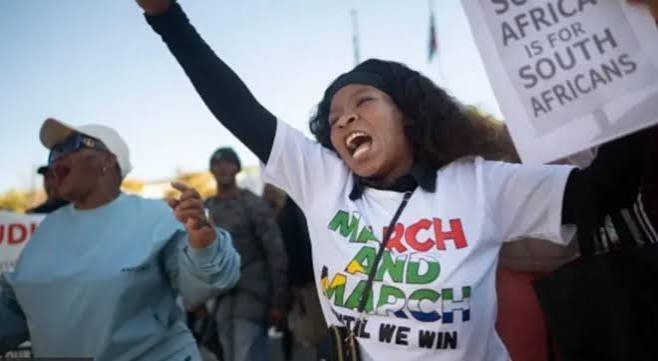
Hundreds of protesters took to the streets of Durban on Wednesday as tensions over immigration continued to rise in South Africa, with organisers signalling that their campaign against undocumented migrants would not end with their latest demonstration.
The protest was led by the March and March movement, which had identified September 30 as an unofficial deadline for undocumented foreign nationals to leave the country. Demonstrations were also reported in other parts of South Africa as the group renewed its demands for tougher action on irregular migration.
The September deadline has no legal authority, as only South African government institutions have the power to enforce immigration laws and carry out deportations. However, the campaign has generated considerable concern among migrant and refugee communities, particularly after months of protests and incidents of violence involving foreign nationals.
Protesters Demand Action on Immigration
March and March supporters have accused the authorities of failing to adequately address illegal immigration and its perceived impact on communities.
During Wednesday’s demonstration in Durban, protesters marched through parts of the city while calling for undocumented foreigners to leave the country. Some participants carried traditional Zulu weapons and sang cultural songs during the procession. Police did not report major incidents of violence against foreigners during the demonstration.
The latest action follows an earlier campaign that set June 30 as a deadline for undocumented migrants to leave South Africa. That campaign was followed by violence in several areas and a large number of foreign nationals leaving the country.
According to an AFP tally cited by Africanews, more than 200,000 people have subsequently left South Africa, based on figures provided by African governments that organised the repatriation of their citizens.
Migrant Communities Remain Concerned
The renewed demonstrations have caused anxiety among migrants and refugees living in South Africa, with some fearing that hostility aimed at undocumented migrants could also affect people with legal status.
South Africa has experienced repeated episodes of anti-foreigner violence, and recent unrest has resulted in deaths and the movement of people out of the country.
The official number of foreign nationals killed during the recent violence remains disputed, with South African authorities and some foreign governments reporting different figures.
The situation has also affected South Africa’s relations with other African countries. Nigeria, for example, has expressed concern following the deaths of three Nigerian nationals in separate incidents between September 18 and 21. Nigerian authorities said the deaths brought the number of Nigerians killed in South Africa during 2026 to 12.
Government Warns Against Taking the Law Into Private Hands
South African authorities have repeatedly stressed that immigration enforcement remains the responsibility of the state.
The government has continued deportation and repatriation operations targeting people who are in the country without valid immigration documents. At the same time, officials have warned individuals and groups against attempting to enforce immigration laws themselves.
Earlier in the year, President Cyril Ramaphosa warned that authorities would respond to attempts to destabilise the country during anti-migrant demonstrations. Security agencies were subsequently deployed in response to the unrest.
The government has also maintained that protests must remain within the law and that no private organisation has the authority to deport people from South Africa.
Protests Also Highlight Gender-Based Violence
Organisers of Wednesday’s demonstrations said their action was not solely focused on immigration. They also linked the protests to concerns about gender-based violence and femicide.
The issue has received renewed national attention following the deaths of women in Ekurhuleni, east of Johannesburg. At least 11 women had been killed there since mid-July, according to Africanews, prompting fresh concern over violence against women.
President Ramaphosa announced new measures on Tuesday aimed at strengthening protections for women, adding another dimension to the country’s ongoing public debate about crime and security.
However, rights activists have criticised the anti-migrant campaign and warned that targeting foreign nationals can contribute to discrimination and violence.
Campaign Expected to Continue
Despite the completion of the September 30 deadline set by March and March, organisers have indicated that they intend to continue campaigning.
The latest demonstrations underline the depth of public debate surrounding immigration, unemployment, crime and access to public services in South Africa. Similar protests earlier in the year have shown that the issue remains highly sensitive and capable of triggering tensions between local communities and foreign nationals.
For migrants and refugees, the continuing demonstrations have created uncertainty over their safety, while the government faces pressure to enforce immigration regulations without allowing private groups to take enforcement into their own hands.
As March and March vows to continue its activities, attention will remain on how authorities respond to future demonstrations and whether tensions surrounding migration can be contained without further violence.