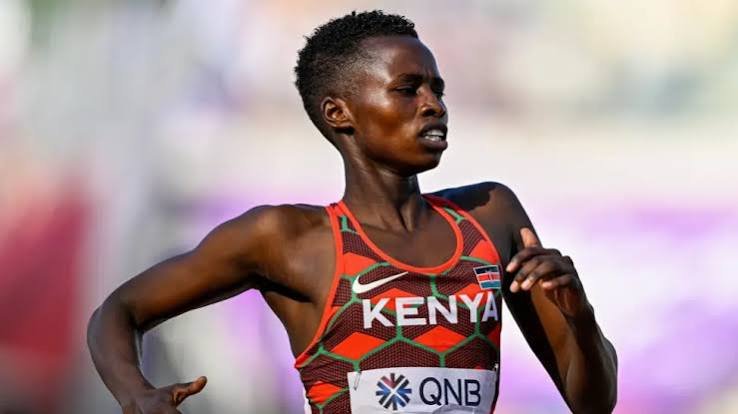
Kenyan middle-distance runner Naomi Korir has revealed how a medical condition she lived with for more than a decade forced her to alter her athletics ambitions before she eventually found a path back to competitive running.
Korir, now 28, was born with a congenital fistula, an abnormal connection between organs that caused continuous urine leakage. The condition made regular training particularly difficult and affected her participation in sport during her childhood.
Despite her love for athletics, Korir said the physical challenges associated with the condition meant she had to reduce the distances she ran.
She eventually turned to the 100m hurdles, choosing a shorter event as a way of managing the problem while remaining involved in athletics.
Medical condition affected her sporting dreams
Korir said she participated in several sports as a young girl, including football, netball, rugby and athletics. However, training became increasingly difficult because of the continuous leakage caused by the fistula.
The condition also affected her social life. According to Korir, sport became an important outlet because she sometimes felt isolated by the condition.
Rather than abandoning athletics altogether, she continued participating in activities she enjoyed while looking for a solution to her medical problem.
Korir’s condition was a genitourinary tract fistula, involving an abnormal opening between the bladder and vagina.
Three surgeries before successful treatment
Korir underwent two operations that did not resolve the problem.
Her situation eventually changed in August 2013, when she underwent a third procedure at Gynocare Hospital in Eldoret. She was 13 at the time.
The operation successfully addressed the condition and gave the young athlete an opportunity to pursue her education and sporting ambitions without the same physical limitations.
Gynocare director Caroline Mabeya said fistula can have consequences beyond its physical symptoms, with women and girls affected by the condition sometimes experiencing stigma, isolation and loss of confidence.
The facility has provided treatment to patients from across East Africa, while also running programmes aimed at helping patients rebuild their confidence after treatment.
Korir’s athletics career takes off
After recovering from surgery, Korir continued developing as an athlete.
She began competing professionally in 2019 and went on to represent Kenya at international competitions.
In 2021, she was part of Kenya’s mixed relay team that won silver at the World Relays in Poland alongside Ferguson Rotich. The following year, she helped Kenya claim gold in the women’s 4x400m relay at the African Championships in Mauritius.
Her biggest individual breakthrough came at the 2026 Commonwealth Games in Glasgow, where she reached the final of the women’s mile and finished fifth.
The performance marked her first appearance in a major global final and represented a dramatic turnaround from the years when her medical condition had threatened to limit her sporting career.
Her story offers hope to other women
For Korir, her journey is about more than athletics.
She has said her experience is intended to encourage young women who may be dealing with difficult circumstances and have begun to lose hope.
Following her surgery, Korir also continued her education through Gynocare’s Young Fistula Programme and completed her secondary education.
Mabeya described Korir’s progress as an example for other women receiving treatment at the facility, saying her story demonstrates that people affected by fistula can rebuild their lives after treatment.
The condition remains a significant health issue in parts of sub-Saharan Africa, where access to specialist medical care can be limited. Doctors Without Borders estimates that hundreds of thousands of women worldwide live with fistula.
Looking beyond the Commonwealth Games
Korir’s ambitions have now moved beyond simply overcoming the challenges of her childhood.
She has set her sights on future international competitions, including the 2027 World Championships in Beijing and the 2028 Olympic Games in Los Angeles.
For an athlete whose running career was once restricted by a condition that made even training difficult, her progress to a Commonwealth Games final represents a significant change in circumstances.
Korir now hopes her sporting journey can serve as encouragement to others facing similar struggles while she continues pursuing further success on the track.