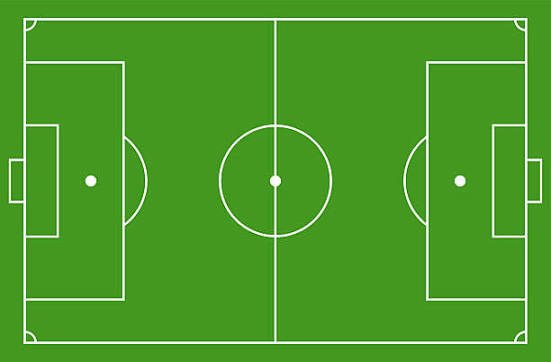
Football is played on a rectangular pitch, but the size of the playing surface can vary depending on the level and type of competition. Understanding football field dimensions is important for players, coaches, stadium planners and fans who want to know how the pitch is laid out.
The International Football Association Board (IFAB), which maintains the Laws of the Game, sets the permitted measurements for football fields. While domestic competitions can select dimensions within the approved range, international matches operate within a narrower set of measurements.
What are the standard football field dimensions?
Under the current Laws of the Game, a football pitch must be rectangular, with the touchline longer than the goal line.
For general matches, the permitted dimensions are:
- Length: 90 to 120 metres (100 to 130 yards)
- Width: 45 to 90 metres (50 to 100 yards)
This means there is no single mandatory pitch size for every football match. Competitions can determine the precise length and width provided they remain within the limits established by IFAB.
Football field dimensions for international matches
International football has more specific requirements.
For matches involving national representative teams, the field must measure:
- Length: 100 to 110 metres (110 to 120 yards)
- Width: 64 to 75 metres (70 to 80 yards)
Therefore, an international football pitch can be considerably narrower in its permitted range than a pitch used under the broader general regulations.
The exact dimensions can still be selected by the relevant competition, provided they fall within these international limits.
How long is a football field?
A football field can be between 90 and 120 metres long under the general Laws of the Game. For international matches, the permitted length is between 100 and 110 metres.
The longer boundaries are known as the touchlines. They run along the sides of the pitch, while the shorter boundaries are called the goal lines.
How wide is a football field?
The width of a football field can range from 45 to 90 metres for general matches.
For international games, the permitted width is narrower, ranging from 64 to 75 metres.
The difference between pitch dimensions can influence the amount of available space during a match. A wider pitch, for example, provides teams with more room across the field, while a narrower surface reduces the lateral space available to players.
Football pitch markings and measurements
Football field dimensions include more than just the overall length and width. The pitch contains several important markings that help officials and players manage the game.
The halfway line divides the field into two equal sections, while the centre mark sits at its midpoint. Around the centre mark is a circle with a 9.15-metre (10-yard) radius.
The penalty area is also carefully measured. It extends 16.5 metres (18 yards) into the field from the goal line. The penalty mark is positioned 11 metres (12 yards) from the midpoint between the goalposts.
The goal area extends 5.5 metres (6 yards) from the inside of each goalpost and into the playing field.
How wide should football pitch lines be?
The lines marking the field must be continuous and clearly visible. Under the Laws of the Game, all lines must have the same width and cannot be more than 12 centimetres (5 inches) wide.
The goal lines must also have the same width as the goalposts and crossbar.
Why football field dimensions matter
Pitch dimensions can affect how football is played. Teams that rely on wide attacking movements may benefit from having more space across the field, while a narrower pitch can reduce the distance between players.
However, the dimensions alone do not determine the style or outcome of a match. Tactics, player positioning, coaching decisions and the quality of the playing surface also influence how teams use available space.
Football field dimensions at youth and grassroots level
Youth, veterans, disability and grassroots football can have modified requirements. IFAB allows certain aspects of the game, including the size of the field, to be modified for these levels under the applicable regulations.
This means a youth football pitch does not necessarily need to match the dimensions used for professional or international competitions.
Football field dimensions at a glance
| Type of match | Length | Width |
|---|---|---|
| General football matches | 90–120 m | 45–90 m |
| International matches | 100–110 m | 64–75 m |
| Centre circle radius | 9.15 m | — |
| Penalty area depth | 16.5 m | — |
| Goal area depth | 5.5 m | — |
| Penalty mark from goal line | 11 m | — |
In summary, football field dimensions are not identical at every stadium. IFAB establishes a range of acceptable measurements, with international matches subject to tighter requirements. This flexible approach allows competitions to select an appropriate pitch size while maintaining the fundamental structure and markings required by the Laws of the Game.