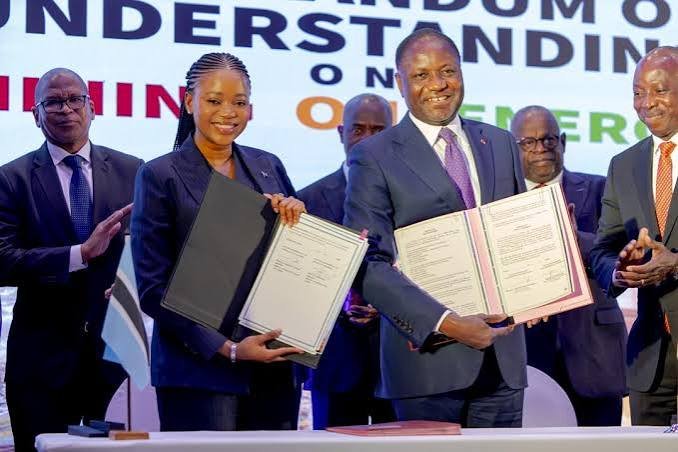
Botswana and Ivory Coast have taken steps towards expanding their economic relationship after signing several cooperation agreements covering mining, energy, agriculture and international trade.
The agreements were reached during a state visit by Botswana’s President, Duma Gideon Boko, to Abidjan, where he held discussions with Ivorian President Alassane Ouattara.
The partnership is expected to create new opportunities for investment, strengthen commercial relations and encourage greater cooperation between the two African economies.
Boko arrived in Abidjan on Monday, November 16, for a three-day official visit. He was received at the presidential palace by Ouattara, with both leaders using the meeting to discuss ways of improving economic relations and unlocking opportunities in strategic industries.
Following their discussions, the two countries signed several agreements intended to provide a stronger foundation for cooperation across different sectors.
Mining and energy emerged as major priorities, particularly as both countries seek to make better use of their natural resources and attract additional investment into their economies.
Mining expertise at the centre of partnership
Botswana’s experience in managing its mineral resources is expected to play an important role in the new relationship.
The southern African country has built a strong mining industry over several decades, particularly through diamond production. Its mineral resources also include gold, copper, coal, nickel and soda ash.
Diamond mining has historically been a major contributor to Botswana’s economy, accounting for approximately 30 per cent of its gross domestic product, according to the report.
Ivory Coast, meanwhile, is working to expand its extractive industry following discoveries and developments involving gold, manganese, coltan, oil and natural gas.
The cooperation arrangement is expected to encourage the exchange of technical knowledge, professional expertise and experience in mineral resource management.
Both governments are also interested in creating an environment that attracts more investment into mining and related industries.
The latest agreements build on an earlier mining and energy cooperation framework signed by the two countries in Gaborone on July 30, 2026.
That arrangement established a basis for collaboration in mineral exploration, geological research and the development of critical mineral resources.
Boko calls for stronger trade between African countries
Beyond mining and energy, the Botswana president used the visit to highlight the importance of improving trade relationships among African nations.
Boko argued that African economies could become more resilient to international economic disruptions by increasing commercial activities within the continent.
He called for governments to address unnecessary restrictions, align trade regulations and improve the conditions under which businesses operate across national borders.
According to the Botswana leader, barriers that make it difficult for African companies to trade with one another continue to limit the continent’s economic potential.
He also suggested that stronger regional partnerships could help African countries reduce their exposure to external challenges, including international conflicts and economic instability.
His position reflects broader efforts to strengthen intra-African trade under the African Continental Free Trade Area (AfCFTA), which officially commenced operations in 2021.
Although the agreement was designed to encourage the movement of goods and services across African markets, significant obstacles remain, including regulatory differences, trade restrictions and infrastructure challenges.
Boko believes that closer cooperation between countries such as Botswana and Ivory Coast could contribute to addressing some of these difficulties.
Ouattara seeks greater investment from Botswana
For Ivory Coast, the partnership represents an opportunity to attract additional capital and technical expertise into important areas of its economy.
Ouattara noted that the existing level of commercial exchange between the two countries does not adequately reflect their economic capabilities.
He encouraged Botswana’s private sector to explore investment opportunities in Ivory Coast, particularly in mining, petroleum and major development projects.
The Ivorian government is also looking to expand its economic activities through its 2026–2030 National Development Plan, which provides a framework for infrastructure development and investment.
Greater involvement from Botswana-based companies could help support these ambitions while creating opportunities for businesses in both countries.
The agreements also extend beyond commercial activities, covering areas of diplomatic cooperation, agriculture and other sectors of mutual interest.
Business forum expected to deepen cooperation
The diplomatic visit also includes engagements designed to connect businesses and investors from both countries.
An Ivory Coast-Botswana economic forum is scheduled for Tuesday, November 17, in Abidjan. The gathering is expected to bring together business leaders and representatives from the public and private sectors to discuss potential investments and commercial partnerships.
The meeting provides an opportunity for companies to identify areas of mutual interest and explore practical ways of implementing the agreements signed by both governments.
Boko is also expected to participate in the opening of the 2026 International Exhibition of Extractive and Energy Resources, known as SIREXE, on Wednesday, November 18.
Botswana has been selected as the guest of honour at the event, giving the country an opportunity to showcase its experience in mineral resource development and engage with investors in the extractive industry.
A new chapter in African economic cooperation
The agreements between Botswana and Ivory Coast reflect growing interest among African governments in building stronger economic partnerships within the continent.
Both countries have important resources and opportunities that could complement each other’s development ambitions.
Botswana brings decades of experience in the mining industry, while Ivory Coast offers opportunities in mineral exploration, energy, agriculture and industrial development.
However, the long-term success of the partnership will depend on how effectively the agreements are translated into actual investments, business opportunities and economic projects.
For both governments, the immediate priority will be turning diplomatic commitments into practical arrangements that benefit businesses, create employment and strengthen economic growth.
The partnership could also serve as an example of how African countries can build commercial relationships across different regions while reducing dependence on external markets.