The death toll among people who crossed into Mali after being expelled from gold-mining areas in Guinea has risen to 10, according to Mali’s crisis management centre. The latest death was confirmed on Wednesday, November 11, as authorities continued medical assistance and organized transport for people seeking to return to their countries of origin.
The arrivals followed a Guinean security operation targeting illegal artisanal gold mining in the Siguiri region. Mali’s Centre for Coordination and Crisis Management (CECOGEC) reported that the number of new arrivals had slowed by November 11, with no new arrivals recorded in Bamako that day and only low flows elsewhere.
The figures have shifted as the situation developed. The World Health Organization (WHO), reporting on conditions as of November 9, said six deaths had been reported in Kourémalé. CECOGEC’s later update put the overall number of deaths in Mali at 10. The reports refer to different dates and coverage, so the earlier WHO figure should not be mistaken for the latest national total.
Thousands reach Bamako and the border area
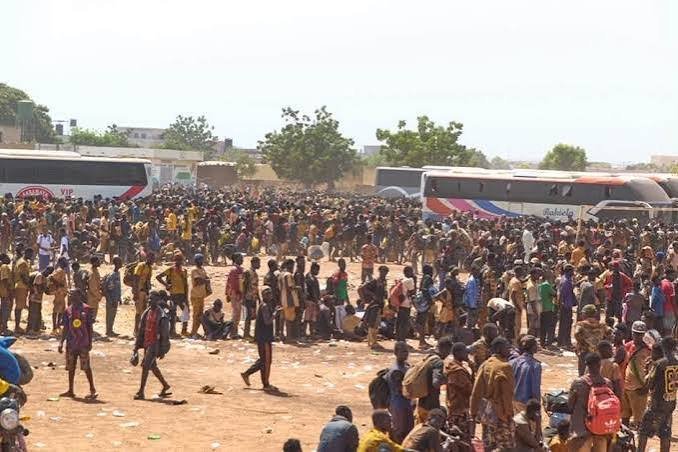
The scale of the movement has strained reception sites and health services. The WHO reported that, by November 9, about 160,000 people had been recorded in Mali: roughly 100,000 in Bamako and 60,000 in the border town of Kourémalé. The affected population includes mostly young adults and adolescents, as well as women, children and other vulnerable people.
Many arrivals are nationals of Burkina Faso, but people from Côte d’Ivoire, Senegal, Togo, Benin and Mali have also been reported among those leaving Guinea. AFP reported that some people arrived exhausted, without money, and separated from family members during the rush to cross the border.
Malian authorities and aid organizations have been providing medical care, food and temporary shelter. The WHO said 413 people had received treatment at health facilities in Bamako by November 9. It warned that overcrowding, inadequate shelter, limited access to safe water and sanitation, and pressure on health services could increase risks including dehydration, respiratory and diarrhoeal illnesses, malnutrition and psychological distress.
Repatriation efforts underway
Mali and Burkina Faso have been organizing convoys to help Burkinabe nationals return home. CECOGEC said Mali dispatched 15 trucks from Kourémalé on November 10 to transport about 1,511 people to Burkina Faso. A separate group of 38 trucks was mobilized in Bamako for an estimated 4,560 people. Burkina Faso also sent 23 buses intended to collect around 1,380 citizens.
These are planned convoy capacities, and the CECOGEC statement did not provide a consolidated count of how many people ultimately reached their destinations in those particular operations. AFP separately reported that Burkina Faso had announced 37,136 arrivals from Guinea through repatriation operations as of November 12.
The Malian government has coordinated the response through its crisis-management structures, with health services, social services, humanitarian organizations and local communities assisting people at reception sites. WHO said it was supporting health coordination, surveillance, emergency medical services and supplies, and had requested additional regional assistance to operate advanced medical posts and strengthen logistics.
Mali calls for coordination with Guinea
Mali’s prime minister, Abdoulaye Maïga, visited Kourémalé and said the two countries shared longstanding ties. He also described Guinea’s operation as uncoordinated with Mali and called for continued consultation between the neighbouring governments, according to the Malian government.
Guinea has said its crackdown is intended to address environmental damage caused by informal gold mining, including land degradation and water pollution, AFP reported. The operation has nevertheless pushed large numbers of miners and their families across the border, creating an urgent humanitarian challenge for Mali.
The immediate priorities are medical care, shelter, food, safe water and support for people separated from relatives, alongside organized transport for those returning home. With arrivals slowing but conditions still changing, authorities and humanitarian organizations continue to monitor needs and coordinate assistance.