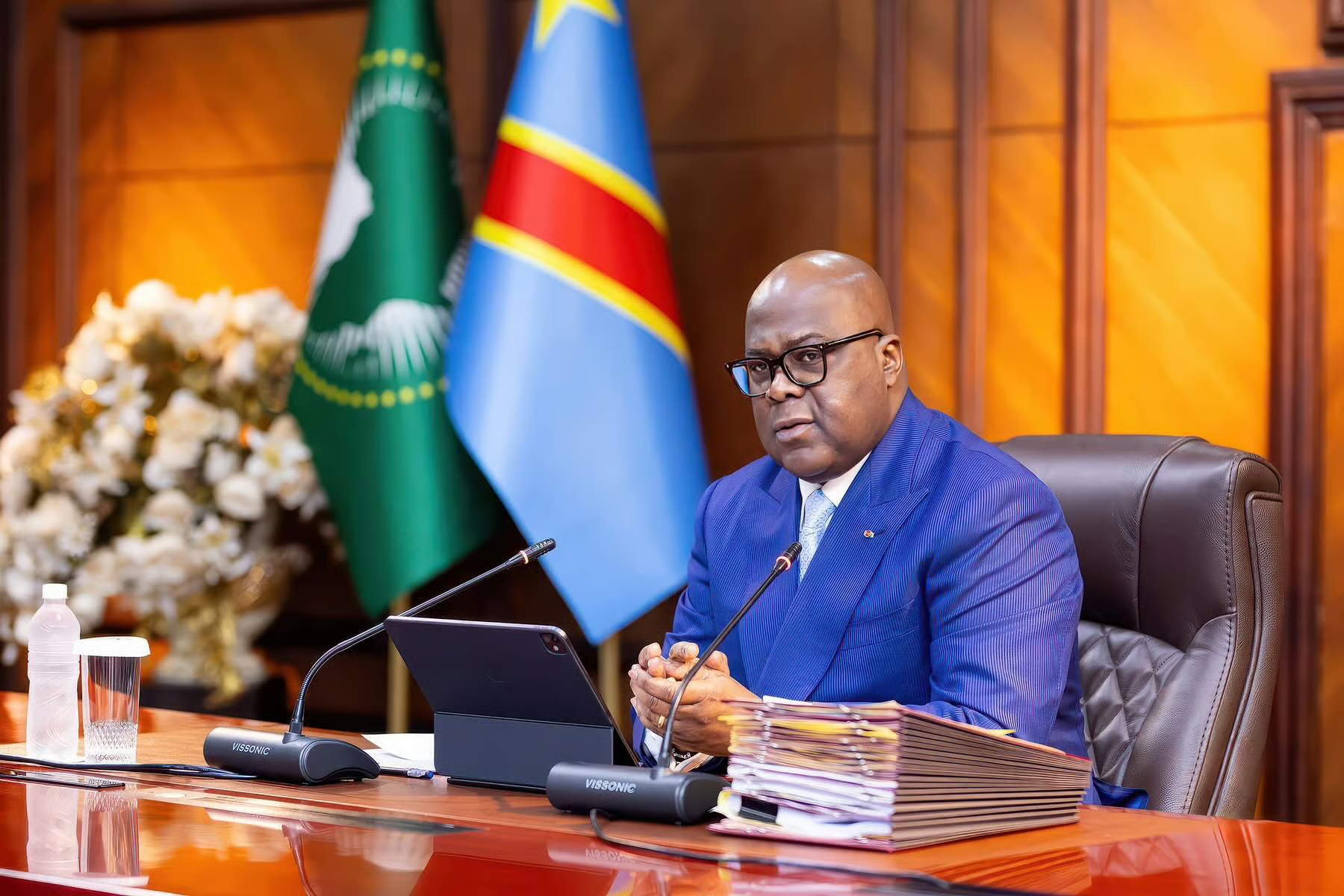
Democratic Republic of Congo President Félix Tshisekedi has signed a law setting out how national referendums can be initiated and conducted, reigniting debate over whether constitutional change could allow him to remain in office beyond his current term.
The law, numbered 26/045 and dated November 9, was promulgated by presidential ordinance. Its adoption was announced on state television on November 10, according to the Congolese Press Agency. It establishes rules covering the purpose and procedure of a referendum, who may initiate one, how it is called and conducted, and how disputes or violations are handled. The law does not itself call a referendum, and no voting date has been announced.
The immediate political dispute is about what the new framework could make possible. Opposition figures and civil society groups fear it could be used to pursue a new constitution or constitutional changes that remove or weaken the presidential term limit. Tshisekedi’s critics say that could provide a route for him to seek a third term. The president has denied that he is seeking one, but has said he would accept another term if voters wanted it.
What the new referendum law provides
The legislation creates a formal process for putting questions or texts to voters. As described by the Congolese Press Agency, it recognizes several potential sources of a referendum initiative: the president, the government after deliberation in the Council of Ministers, half the members of either parliamentary chamber, or a petition signed by at least 100,000 Congolese citizens. The law also provides for the conduct of referendum campaigns and voting, participation by observers and journalists, and procedures for resolving disputes.
Those provisions establish a mechanism; they do not establish that any particular referendum will take place. No question has been put to voters, and the government has announced no date for a vote. Nor does signing the law, by itself, amend the constitution or extend Tshisekedi’s presidency. Those distinctions matter as the political debate has often folded the law, a possible future referendum and a possible third-term bid into one claim.
The law was approved by both houses of parliament after a drawn-out process. Reuters reported that the legislature approved it in October, while the Congolese Press Agency said the measure was subsequently promulgated under the number 26/045. The text provides the legal framework for a referendum, while the political controversy centers on how that framework might be used.
Why opponents fear a third-term route
Tshisekedi is serving his second term, which is due to end in 2028. The 2006 constitution says the president’s term is renewable once, and identifies the number and duration of presidential terms among provisions that cannot be revised. The official text describes these protections as safeguards against political changes that could undermine the constitution’s democratic principles.
That creates the central legal and political tension. A referendum framework can enable direct consultation of voters, but opponents argue that a vote cannot simply erase constitutional limits that are explicitly protected. Their concern is that a new constitution—or a proposal presented as a broader constitutional overhaul—could be used to reset how terms are counted and enable Tshisekedi to run again. The Associated Press reported that critics see the legislation as opening a possible path to a new constitution under which his earlier terms might not count.
That is an opposition concern, not an accomplished legal outcome. The referendum law has not removed the term limit, and the president has not announced a third-term candidacy. Whether a proposed referendum could lawfully alter protected provisions, and what role the courts would play in such a dispute, would depend on the specific proposal and the legal process that followed.
Tshisekedi’s statements and the 2028 election
Tshisekedi’s own remarks have helped intensify the debate. In May, he said he had not sought a third term but would accept one if the Congolese people wanted it. He also linked the prospect of holding the 2028 elections to the conflict in the east, saying that elections could not be organized if fighting continued and the government could not restore control in North and South Kivu.
The president’s comments connect two sensitive issues: the country’s security crisis and the constitutional timeline. His supporters may point to insecurity and territorial control as practical barriers to holding elections on schedule. Critics fear those arguments could be used to justify extending his stay in office. The comments have heightened suspicion, but they do not in themselves change the election calendar or authorize a term extension.
The eastern conflict is a serious challenge for the state. Fighting involving the M23 rebel movement and other armed groups has disrupted life in multiple provinces and contributed to a major humanitarian crisis. The Associated Press has reported millions of displaced people and stalled peace efforts. That context shapes the political debate, but it is separate from the legal question of whether the constitution permits a president to serve beyond two terms. Protests and opposition criticism
The referendum legislation has triggered demonstrations and sharp opposition criticism. In September, police used tear gas to disperse protesters in Kinshasa who opposed constitutional changes they said could allow Tshisekedi to seek another term. Earlier protests also met with a police response, and clashes were reported at a June rally.
The protests reflect concern over more than the text of one law. They are taking place amid mistrust between the government and opposition parties, disputes over the constitution, insecurity in the east and questions about the credibility of political institutions. Opposition groups describe the proposed constitutional process as a threat to democratic safeguards. Government supporters, by contrast, may argue that a referendum offers voters a direct say in major national questions.
The way the process is administered will therefore matter. The new law includes provisions on observers, journalists, campaign procedures and legal disputes. Public confidence will depend on whether any future referendum is clearly defined, transparently organized and open to meaningful scrutiny. The law’s existence does not guarantee those conditions; they would need to be demonstrated in practice.
What happens next
For now, the confirmed development is that Tshisekedi has promulgated a referendum law that establishes procedures for future votes. The law does not announce a vote, determine its question or decide whether the constitution will change. No referendum date has been announced. The current constitution still sets a two-term limit and protects the number and duration of presidential terms from revision.
The next signs to watch will be any official proposal for a referendum, the wording of the question, the legal basis cited for it, and the response of parliament, the courts, opposition groups and civil society. Until those steps occur, claims that Tshisekedi has already secured a third term—or that a referendum has been scheduled—go beyond what has been announced.
The new law has nonetheless raised the political stakes ahead of 2028. For supporters, it creates a channel for direct popular consultation. For opponents, it risks weakening a constitutional barrier designed to prevent a leader from extending his rule. The central question is no longer just whether Congo has a referendum procedure; it is whether any future use of that procedure can command public trust while respecting the country’s existing constitutional limits.