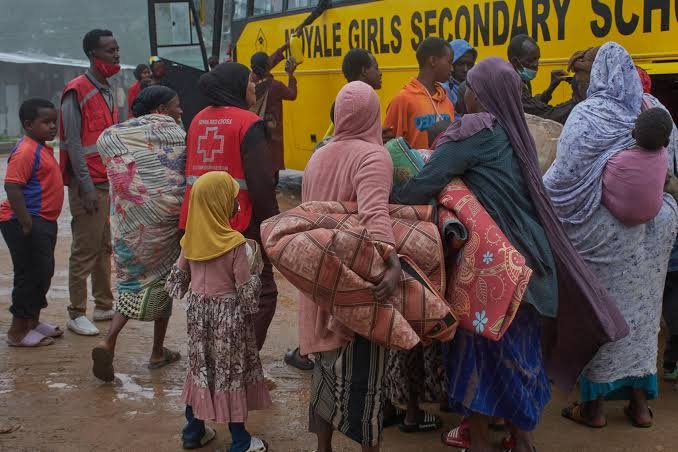
Thousands of Ethiopians who escaped violent clashes in their home country are awaiting formal registration in Kenya as humanitarian agencies work to provide protection and assistance to the growing number of displaced people.
The refugees crossed into Kenya through the border town of Moyale in Marsabit County, fleeing tensions linked to a dispute between Ethiopia’s Oromia and Somali regional administrations.
According to the United Nations High Commissioner for Refugees (UNHCR), approximately 50,000 people had crossed into Kenya by October 29, highlighting the scale of the humanitarian crisis. The latest figure represented a significant increase from the 36,000 arrivals recorded just two days earlier.
Many of those arriving are women and children, with some finding temporary accommodation in schools, churches and local communities while others remain in designated camps.
Displaced families await registration in Moyale
Thousands of Ethiopian nationals were expected to undergo registration on Monday at Al-Huda Primary School in Moyale, where displaced people had gathered for processing.
The arrivals had received temporary international protection status from UNHCR and were waiting for officials to complete the necessary registration procedures.
The exercise is important because accurate records will help humanitarian organisations identify displaced families, assess their needs and coordinate the delivery of assistance.
However, the increasing number of people crossing the border has placed additional pressure on registration and humanitarian operations.
UNHCR’s representative in Kenya, Fatima Mohammed-Cole, warned that the number of arrivals could continue changing as the situation remained unpredictable.
The agency has deployed an emergency team to the affected region and is working with the Kenyan government and humanitarian partners, including the Red Cross, to support those who have fled the violence.
Regional dispute behind the violence
The displacement crisis is linked to tensions between the Oromia and Somali regional administrations in Ethiopia.
The unrest reportedly intensified around October 20 after a Somali regional flag was raised on the Ethiopian side of Moyale, an area jointly administered by the two regional authorities.
The incident heightened an existing dispute over local administration and territorial boundaries, triggering confrontations that forced residents to seek safety across the Kenyan border.
The violence has reportedly resulted in several deaths, although figures and details surrounding individual incidents have varied across reports.
The situation has also disrupted commercial activities around the border, with transport and cargo movements affected as insecurity raised concerns among traders and residents.
Women and children among those affected
Women and children make up a substantial proportion of the people fleeing the clashes, according to UNHCR.
For many families, crossing into Kenya has not immediately brought an end to their difficulties. Some have been forced to depend on relatives and residents in host communities, while others are staying in temporary shelters with limited access to basic necessities.
Food, clean drinking water, accommodation, sanitation and healthcare remain among the most pressing needs.
The Kenya Red Cross and other humanitarian organisations have been involved in providing emergency support, including medical services, food and shelter materials.
Local residents have also assisted displaced families by offering accommodation and other forms of support. However, the growing influx has raised concerns about whether communities in Moyale have enough resources to accommodate so many additional people.
A separate report by Kenya’s Daily Nation said UN agencies were seeking approximately 1.16 billion Kenyan shillings, equivalent to about $8.9 million, to support around 50,000 displaced people over three months. The proposed assistance would cover food, shelter, water, sanitation, registration and protection services.
Humanitarian agencies face growing pressure
The rapid increase in arrivals has created an urgent need for better coordination between Kenyan authorities and international relief organisations.
UNHCR is working alongside the International Organization for Migration (IOM), UNICEF, the Kenya Red Cross and other partners to assess the situation and organise assistance.
The agencies are also considering the needs of host communities, which are providing shelter and other support despite facing their own economic and resource challenges.
The IOM has indicated that response planning could cover as many as 80,000 people, taking into account the possibility of further arrivals. This is a planning figure rather than a confirmed count of people who have crossed the border.
For Kenya, the situation presents both a humanitarian and logistical challenge. Authorities must ensure that displaced people receive protection while maintaining security along the border and supporting communities hosting the new arrivals.
The registration exercise in Moyale is therefore an important part of the wider response. Establishing accurate records will help agencies determine how many people require assistance and identify particularly vulnerable households.
Meanwhile, the situation inside Ethiopia remains a major concern. Unless tensions between the Oromia and Somali regional administrations are addressed, more civilians could be forced to leave their homes.
For thousands already in Kenya, the immediate priority is access to safety, food, shelter and reliable humanitarian assistance as they wait for their registration and the next steps towards longer-term protection.