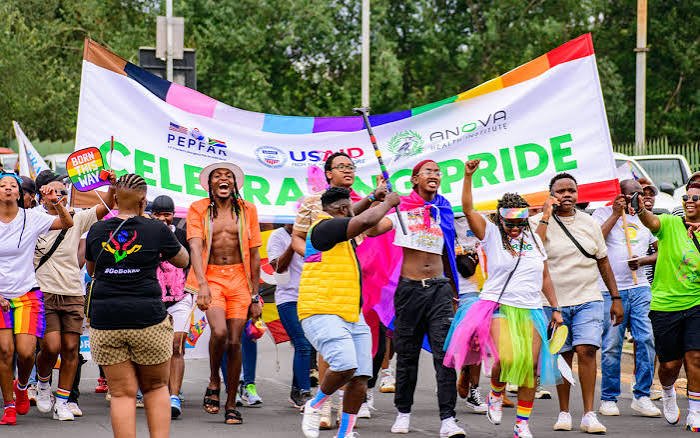
Hundreds of people took to the streets of Sandton, Johannesburg, on Saturday, October 31, to celebrate LGBTQ+ Pride in South Africa, turning the city’s financial district into a colourful display of diversity, self-expression and calls for equal rights.
The annual event attracted members of the LGBTQ+ community, supporters and visitors from different parts of the world. Participants marched through the streets carrying rainbow flags, colourful banners and messages promoting acceptance and inclusion.
Many attendees wore elaborate costumes and bright outfits, using the occasion to express their identities and celebrate the freedom to live openly.
Johannesburg Pride remains one of Africa’s prominent annual LGBTQ+ gatherings, bringing together people who want to celebrate progress in South Africa while drawing attention to discrimination and challenges affecting LGBTQ+ communities across the continent. <Cite refs={[“turn385424search0″,”turn385424search1”]}/>
Sandton Streets Filled With Colour and Celebration
The celebration transformed parts of Sandton into a lively gathering as participants joined the march and associated festivities.
Rainbow flags and colourful placards were prominent throughout the event, while attendees used clothing, music and public displays of solidarity to communicate messages of acceptance.
For many participants, Pride was more than a social gathering. It provided an opportunity to express themselves without fear of judgement and connect with others who share similar experiences.
The 2026 celebration also attracted people from outside South Africa, highlighting the international interest in Johannesburg’s annual Pride activities.
One participant, Patrick Smit-Stachowski, said he attended partly to protest against restrictions on transgender people’s rights in other countries, including the United States.
His comments reflected a wider concern among participants that legal protections and social acceptance can face setbacks even in countries where progress has already been made. <Cite refs={[“turn385424search0″,”turn385424search1”]}/>
Pride Celebration Also Highlights the Fight for Equality
Although Johannesburg Pride is widely recognised as a celebration, it also carries an important advocacy message.
Participants and organisers use the occasion to promote equal treatment, challenge prejudice and encourage greater acceptance of LGBTQ+ people.
The event comes as LGBTQ+ communities in several African countries continue to face legal restrictions, discrimination and social hostility.
South Africa has a comparatively progressive legal framework. Its Constitution prohibits discrimination based on sexual orientation, making it the first country in the world to explicitly include such protection in its constitution.
The country also became the first in Africa to legalise same-sex marriage, with the Civil Union Act taking effect in 2006.
However, legal recognition does not automatically eliminate discrimination. LGBTQ+ people in South Africa continue to face challenges involving social acceptance, safety and equal access to opportunities.
For this reason, Pride events remain significant spaces for visibility, community support and public discussion about human rights. <Cite refs={[“turn385424search0″,”turn385424search3”]}/>
South Africa’s Position on LGBTQ+ Rights
South Africa occupies a distinctive position on LGBTQ+ rights compared with many other African countries.
Its constitutional protections and recognition of same-sex marriage have made it an important destination for LGBTQ+ advocacy and public celebrations.
Johannesburg Pride has developed into a major annual event, attracting thousands of people in recent years.
The 2026 gathering took place in Sandton, with the main march scheduled for the afternoon. The event programme also included entertainment, performances, food vendors and activities designed to bring participants together.
The celebration offered an opportunity to recognise progress made in South Africa while acknowledging that the experience of LGBTQ+ people varies significantly across the African continent. <Cite refs={[“turn385424search2″,”turn385424search5″,”turn385424search6”]}/>
LGBTQ+ Communities Continue to Face Challenges Across Africa
Despite South Africa’s legal protections, LGBTQ+ people in other parts of Africa continue to encounter difficult conditions.
Some countries maintain laws criminalising same-sex relationships, while others have introduced or strengthened restrictions affecting LGBTQ+ individuals and organisations.
These differences have made regional advocacy increasingly important, with activists calling for greater protection against discrimination and violence.
Johannesburg Pride therefore attracts attention beyond South Africa because it provides a platform for conversations about equality and human rights across the continent.
For some attendees, participating in the march is an expression of personal identity. For others, it is a way of supporting friends, relatives and communities facing discrimination.
The event also highlights the importance of creating safe environments where people can express themselves without intimidation.
Johannesburg Pride Strengthens Its Place on Africa’s Calendar
The annual celebration has become an established feature of Johannesburg’s cultural calendar, combining entertainment with advocacy and community engagement.
Its growth reflects the continued importance of public gatherings that promote visibility and encourage discussions about social inclusion.
The 2026 event brought together participants through a shared message of acceptance, while its colourful displays provided a visible reminder of the diversity within South African society.
Although challenges remain, organisers and supporters continue to use Pride as an opportunity to encourage dialogue and highlight the need for equal treatment.
For the participants who gathered in Sandton, the message was clear: celebrating identity and demanding respect can go hand in hand.
As Johannesburg Pride continues to attract attention, its influence extends beyond the streets of Sandton, contributing to wider conversations about equality, freedom and human rights in Africa.