Morocco has officially entered a new political chapter after Fatima Ezzahra El Mansouri assumed her duties as Head of Government, succeeding Aziz Akhannouch following a formal transfer of power in Rabat
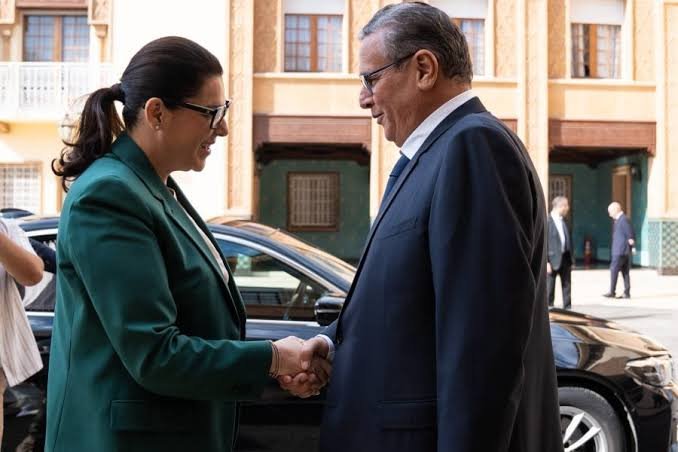
The handover ceremony took place on Saturday, October 17, 2026, at the headquarters of the Head of Government, marking an important step in the country’s transition to its first female-led government.
El Mansouri and Akhannouch used the occasion to review major government projects and discuss the need to maintain progress on national development priorities. Their discussions covered social programmes, economic activity and improvements to public administration.
The transition followed King Mohammed VI’s appointment of the new cabinet on Friday, October 16, completing a process that began after Morocco’s parliamentary elections in September.
El Mansouri’s appointment represents a historic milestone in Moroccan politics, while the new administration faces immediate pressure to address economic concerns, improve public services and deliver on its development commitments.
El Mansouri Begins Duties After Formal Handover
The transfer of responsibilities took place at the government headquarters in Rabat, where El Mansouri officially received the duties previously held by Akhannouch.
In a statement shared through her social media accounts, the new Head of Government highlighted the importance of institutional continuity and responsible public service. She described the handover as part of Morocco’s established administrative practices for transferring government responsibilities.
During their meeting, the two leaders reviewed ongoing strategic initiatives and discussed how the incoming administration could maintain momentum in implementing national priorities.
Particular attention was given to social development programmes, efforts to support economic growth and measures intended to improve the performance of public institutions.
The meeting also underscored the importance of coordination across government departments to ensure that ongoing projects continue without unnecessary disruption during the leadership change.
Morocco Makes History With Its First Female Head of Government
El Mansouri’s appointment marks a significant moment for women’s political representation in Morocco, making her the first woman to lead the country’s government.
Born in Marrakech on January 3, 1976, she has built her political career through the Authenticity and Modernity Party (PAM), one of Morocco’s major political organisations.
Before becoming Head of Government, she served as Minister of National Territory Planning, Urban Planning, Housing and City Policy from 2021 to 2026. She also served as mayor of Marrakech, gaining experience in local administration and national policymaking.
Her political background includes work on urban development, housing policy and the management of public affairs.
King Mohammed VI appointed El Mansouri to lead the government on September 29, following the parliamentary elections held on September 23. Her party emerged as the largest political force in the new parliament, paving the way for her to form a governing coalition.
Her appointment has attracted attention because of its historical significance, but her administration will ultimately be judged by its ability to address the country’s economic and social challenges.
Four Political Parties Form Morocco’s New Government
El Mansouri’s administration is supported by a coalition comprising four political parties: PAM, the Istiqlal Party, the Socialist Union of Popular Forces (USFP) and the Party of Progress and Socialism (PPS).
Together, the parties control 207 of the 395 seats in Morocco’s House of Representatives, giving them a parliamentary majority above the 198 seats required.
The coalition agreement followed negotiations aimed at establishing a stable government capable of implementing its policy priorities.
One notable development is the absence of Akhannouch’s National Rally of Independents (RNI) from the new governing alliance. The party, which previously led the government, secured 66 seats in the September elections but will now sit outside the governing coalition.
The change signals a shift in Morocco’s political arrangements after five years under Akhannouch’s leadership.
However, the formation of a new government does not necessarily mean a complete departure from existing policies. Major national priorities, including economic development and social reform, are expected to remain central to the administration’s agenda.
Economic Growth and Social Reforms Await the New Administration
El Mansouri takes office at a time when Morocco faces significant expectations over employment, education, healthcare and household purchasing power.
Unemployment, particularly among young people, remains an important concern. Public demands for better educational opportunities and improved healthcare services have also placed pressure on political leaders to demonstrate tangible results.
The new government will therefore need to translate its policy commitments into programmes that improve living conditions and expand economic opportunities.
Investment promotion is another important priority. Morocco has been developing its manufacturing, automotive, aerospace and renewable energy industries while pursuing major infrastructure projects.
The country is also preparing for the 2030 FIFA World Cup, which it will co-host with Portugal and Spain. Preparations involve substantial investment in transport, stadiums, tourism infrastructure and other facilities.
These projects could create employment and stimulate economic activity, although their broader benefits will depend on effective implementation and how widely the resulting opportunities are distributed.
El Mansouri’s administration must also manage public finances while balancing investment needs with demands for improved social protection.
The success of these efforts will be an important measure of the new government’s performance.
Public Administration and National Development Remain Priorities
The discussions between El Mansouri and Akhannouch highlighted the importance of maintaining ongoing government programmes during the transition.
Administrative efficiency will be particularly important as the new cabinet takes responsibility for projects spanning several ministries and public institutions.
Improving coordination, reducing delays and ensuring that public spending produces measurable results could help the government deliver on its commitments.
The new administration must also maintain continuity in major national initiatives while responding to changing economic conditions and public expectations.
Morocco’s constitutional system gives King Mohammed VI substantial authority over key strategic areas, including defence and foreign policy. Consequently, while the new government will oversee domestic policy and public administration, a change in leadership does not automatically imply a major shift in the country’s overall strategic direction.
What El Mansouri’s Leadership Means for Morocco
The formal handover between El Mansouri and Akhannouch represents more than an administrative change. It marks the beginning of a new governing period following a competitive parliamentary election and the formation of a different political coalition.
For El Mansouri, the immediate challenge is to establish an effective working relationship across the cabinet, maintain parliamentary support and demonstrate progress on issues affecting ordinary Moroccans.
Her experience in local government and national administration provides a foundation for the role, but expectations will be high given the historic nature of her appointment.
The government must now focus on delivering economic opportunities, strengthening public services and advancing the country’s development agenda.
As Morocco’s first female Head of Government, El Mansouri begins her tenure with a historic distinction. Whether that milestone translates into lasting political and economic gains will depend on the decisions her administration makes and the results it delivers.