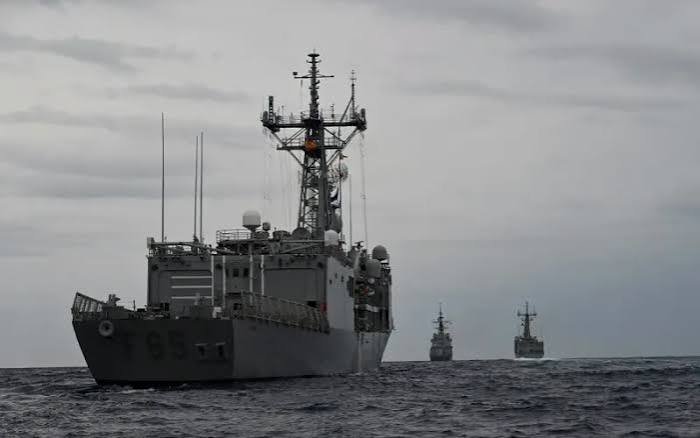
Tensions between Morocco and Spain have resurfaced following reports that Moroccan naval vessels entered waters claimed by Spain near Ceuta during the migration crisis in July 2026. However, a commentary published by Morocco World News has challenged the legal basis of the allegations, arguing that the precise maritime boundaries and the location of the vessels must be established before a violation of Spanish sovereignty can be confirmed.
The debate intensified after Spanish newspaper El País reported that Moroccan warships and patrol boats had entered waters claimed by Spain without requesting permission. Spanish Prime Minister Pedro Sánchez subsequently acknowledged that a naval incident had occurred during a period of heightened tensions between the neighbouring countries.
In its response, Morocco World News questioned whether the available information was sufficient to establish that the Moroccan vessels had violated Spanish territorial waters. The commentary, written by Samir Bennis, argued that the report did not provide the coordinates or detailed legal analysis needed to verify the allegation.
The disagreement highlights a longstanding source of friction between Rabat and Madrid: the sovereignty dispute surrounding Ceuta and Melilla, two Spanish-administered territories on the North African coast.
Disputed Maritime Boundaries at the Centre of the Controversy
One of the main arguments raised by Morocco World News concerns the absence of an agreed maritime boundary between Morocco and Spain around Ceuta.
Although Spain administers Ceuta and considers it part of its territory, Morocco does not recognise Spanish sovereignty over the enclave. This disagreement has complicated discussions about the maritime areas surrounding the city and neighbouring Melilla.
According to the Morocco World News commentary, establishing whether a naval vessel crossed into another country’s territorial waters requires more than relying on a general claim that an incident occurred. Authorities would need to identify the vessels’ precise positions and explain how the applicable international maritime rules determine the boundary.
The article argues that the El País report did not provide sufficient geographical evidence to establish where the Moroccan vessels were operating or whether they entered waters legally attributable to Spain.
However, the absence of a bilateral maritime delimitation agreement does not automatically mean that territorial waters cannot be identified. The legal position depends on the relevant geography, international law and the circumstances of the incident.
Consequently, determining whether a violation occurred would require more detailed evidence than the competing public statements have so far provided.
What International Maritime Law Says
The controversy has also drawn attention to the United Nations Convention on the Law of the Sea (UNCLOS), the international treaty that establishes rules governing maritime boundaries and navigation.
Article 15 of the convention addresses the delimitation of territorial seas between states with adjacent or opposite coastlines. In general, where the countries have not agreed on a boundary, neither may extend its territorial sea beyond the median line, subject to exceptions involving historic title or special circumstances.
Morocco World News argues that these principles are relevant to the waters around Ceuta because of the enclave’s proximity to the Moroccan mainland.
The commentary also points to Spanish domestic legislation, which recognises limitations on the extent of territorial waters where maritime boundaries with neighbouring countries are involved.
Nevertheless, applying these rules to the reported incident would require accurate information about the vessels’ movements and the relevant coastal geography.
The central legal question is therefore not simply whether Moroccan warships were present near Ceuta, but whether their movements crossed a boundary recognised under the applicable rules of international law.
Until the relevant positions and circumstances are established, the allegation remains disputed.
Could Moroccan Warships Have Been Exercising a Right of Passage?
Another issue raised by the commentary is whether the Moroccan vessels were travelling through an international strait or navigating within territorial waters.
Ceuta is situated near the Strait of Gibraltar, a strategically important maritime corridor connecting the Mediterranean Sea with the Atlantic Ocean.
UNCLOS provides for transit passage through international straits used for international navigation. Under this regime, ships and aircraft enjoy specific navigation rights, subject to the convention’s provisions.
The commentary argues that the nature of the vessels’ movements matters because ordinary transit through an international strait may be treated differently from military activities conducted within a coastal state’s territorial sea.
UNCLOS also recognises the right of innocent passage for ships navigating through another state’s territorial sea, provided their passage meets the convention’s conditions.
However, these rights do not mean that every military operation is automatically lawful. Activities that threaten a coastal state’s security or fall outside the applicable passage regime may raise different legal questions.
For that reason, establishing what the Moroccan vessels were actually doing would be essential to assessing the incident.
The publicly available accounts cited in the controversy do not, by themselves, settle whether the vessels were engaged in ordinary navigation, military manoeuvres or activities that violated international maritime rules.
Sánchez Acknowledges Naval Tensions Between Morocco and Spain
The controversy gained further attention after Spanish Prime Minister Pedro Sánchez acknowledged that tensions between the two countries’ navies had arisen during the migration crisis.
According to El País, Sánchez confirmed that Moroccan naval vessels had entered waters Spain considers its own during the period of heightened tensions around Ceuta in late July.
He reportedly described the period as difficult and indicated that communication between the two navies had taken place at a high level to address the situation.
Sánchez also stressed the importance of maintaining constructive relations with Morocco, which remains a significant partner for Spain on issues including migration management, counterterrorism and the fight against drug trafficking.
His remarks acknowledged the existence of a sensitive diplomatic episode but did not, on their own, establish a definitive legal finding concerning the maritime boundary.
Morocco World News draws a distinction between acknowledging that an incident occurred and proving that a specific international law violation took place.
That distinction is central to the ongoing debate over how the episode should be interpreted.
Migration Crisis Adds to Diplomatic Sensitivities
The reported naval encounter took place against the backdrop of a major migration crisis involving Ceuta.
The situation heightened security concerns and placed additional pressure on relations between Rabat and Madrid. According to the reports discussed by El País, the movement of Moroccan naval vessels occurred during the same period, prompting concerns within Spain’s political and security establishment.
The overlap between the migration emergency and the naval incident has increased the political significance of the allegations.
However, Morocco World News argues that the two issues should not automatically be treated as proof of hostile intent by Morocco.
The commentary suggests that describing the naval movements as a deliberate violation without providing the relevant evidence risks turning a disputed legal question into a broader political confrontation.
At the same time, Spain has the right to investigate incidents it believes may have affected its territorial waters and to raise its concerns through diplomatic channels.
The challenge for both countries is to address the disagreement without allowing competing interpretations to undermine their wider bilateral relationship.
Timing of the Report Raises Political Questions
The publication of the El País report also attracted attention because it appeared shortly before a planned visit by Spain’s King Felipe VI to Ceuta and Melilla.
The royal visits were significant because they involved territories at the centre of a longstanding disagreement between Spain and Morocco.
In its commentary, Morocco World News questioned whether the timing of the report could influence public perceptions of Morocco’s intentions and increase political pressure during an already sensitive period.
However, questions about timing do not establish that the reporting was politically motivated. Assessing that possibility would require evidence beyond the fact that the article appeared shortly before the royal visits.
The episode nevertheless illustrates how disputes involving Ceuta and Melilla can quickly become sensitive diplomatic issues, particularly when questions of territorial sovereignty, migration and military activity intersect.
Both governments have strategic reasons to manage their relationship carefully, given their cooperation on security, trade and migration.
What Happens Next?
The controversy over the alleged naval incursion highlights the importance of reliable evidence in disputes involving maritime boundaries.
For Spain to establish that its territorial waters were violated, the relevant authorities would need to clarify the vessels’ positions, identify the applicable maritime boundary and explain why the reported activities constituted a breach of international law.
Morocco World News argues that the El País report did not provide enough information to establish those points conclusively.
Nevertheless, the absence of publicly presented coordinates does not prove that no violation occurred. It means that the available reporting alone is insufficient to settle the legal question independently.
Further clarification from the Spanish and Moroccan authorities could help establish what happened and whether any international maritime rules were breached.
Diplomatic engagement may also prove important in preventing the incident from escalating into a wider confrontation.
Ultimately, the central issue remains whether the Moroccan vessels entered waters legally attributable to Spain and, if so, whether their activities violated the rules governing navigation in those waters.
Until those questions are answered with reliable evidence and a clear legal assessment, the allegation should be distinguished from a formally established violation.